BioJejak and Palm Certification: MSPO, ISPO, RSPO, ISCC and Verra
Summary
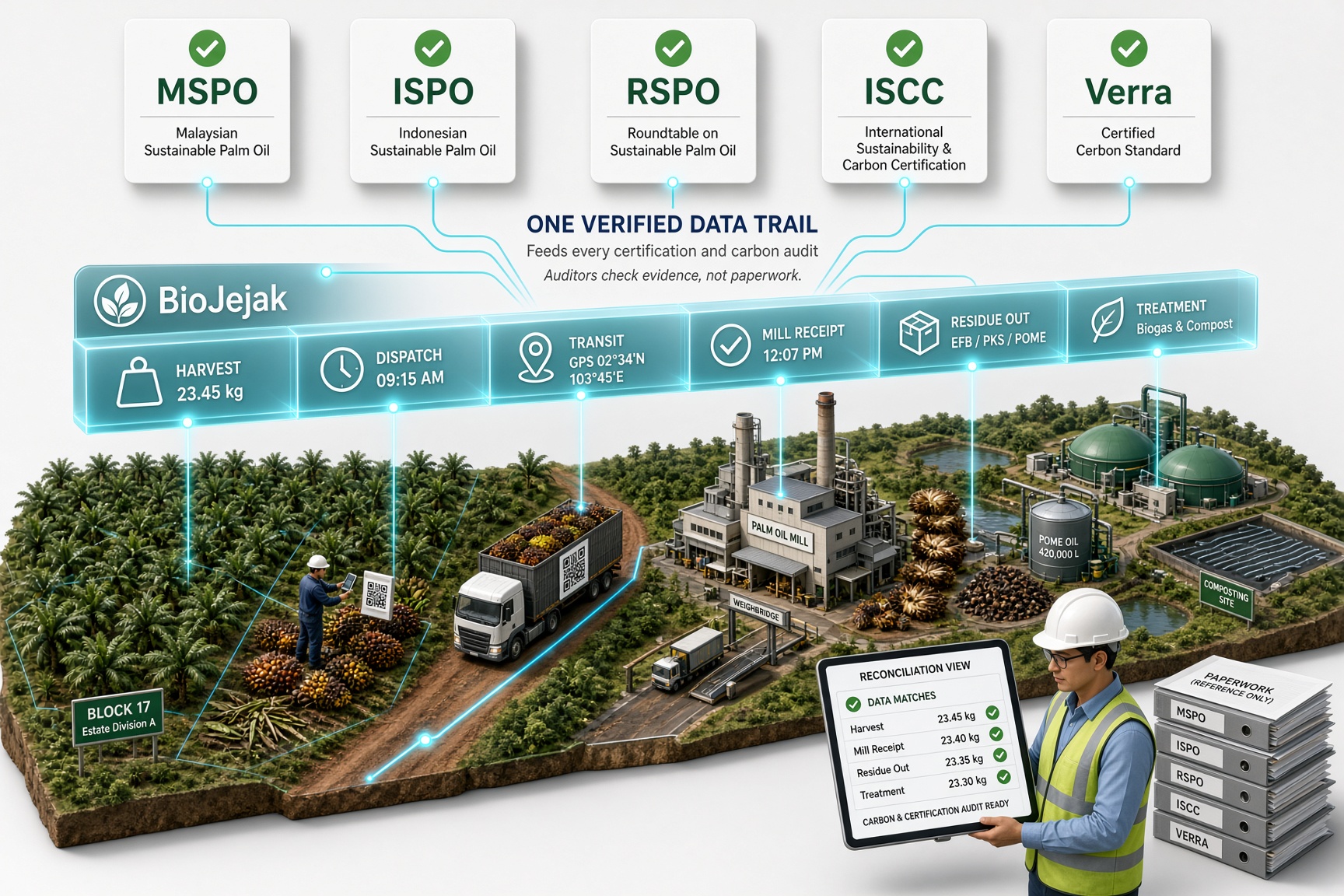
BioJejak should position itself as the first-mile data layer underneath palm certification, not as another scheme. MSPO, ISPO, RSPO and ISCC each already mandate an official reporting system (MSPO Trace, ISPO's certification records, prisma, the EU Union Database). None of them captures reliable data where risk enters: the estate block, the FFB dealer, the smallholder, and the mill's waste and residue streams. The same gap exists on the carbon side: Verra's VCS Program, the standard BioJejak's carbon module was built around and the one Bursa Carbon Exchange adopted, depends on monitoring evidence from exactly these points.
BioJejak's traceability module records those hand-offs as verified, append-only custody events. Its carbon accounting module turns the same records into batch-level emissions evidence. Together they let a certified operator export clean data into each scheme's system and defend it at audit, while keeping carbon credit claims separate from certification GHG claims so nothing is counted twice.
The schemes at a glance
All four certification schemes have tightened first-mile traceability since 2024, and two of them now reach directly into biomass and waste. Verra sits alongside them as the crediting standard for emission reductions.
| Scheme | Status | Official system | What it now demands at the first mile |
|---|---|---|---|
| MSPO 2.0 (MS2530:2022) | Mandatory in Malaysia, in force 1 Jan 2025 | MSPO Trace | Certification of dealers and FFB collection centres; mill certified output derived from certified FFB received times average OER; voluntary biomass chain of custody under MS 2751:2022 |
| ISPO (Perpres 16/2025) | Mandatory in Indonesia; smallholders from March 2029 | ISPO certification records, electronic mark | Mass balance and segregation models; geolocation of production sites downstream; a specific palm kernel shell traceability scheme |
| RSPO (2024 P&C and ISH) | Voluntary, market-driven | prisma | Certified FFB volume as the start of every claim; FFB announcements from smallholders to mills; revised supply chain standard due for endorsement September 2026 |
| ISCC EU (RED III) | Voluntary, gateway to EU biofuel and SAF markets | ISCC database and EU Union Database | POME oil and EFB oil certified as wastes at Point of Origin; annual on-site mill audits since November 2022; UDB tracing being extended upstream to raw material origin |
| Verra VCS | Voluntary carbon crediting; standard adopted by Bursa Carbon Exchange | Verra Registry | Monitoring data proving baseline and project emissions per methodology; periodic methodology reviews that can retire CDM methods or replace their tools with VCS versions |
The common gap is evidence. Each system records what operators declare; none independently verifies weights, routes and hand-offs before they are declared.
Traceability module: from custody record to certification claim
The traceability module tags each batch with a QR code at source and writes every hand-off (harvest, dispatch, transit, receipt, processing, sale) to an append-only ledger with weight, time, location and the certification status of the party holding it. Each record maps to a specific scheme requirement.
| BioJejak record | Schemes it serves | How it is used |
|---|---|---|
| Block harvest tag (estate, block, bunch count, weight) | MSPO, ISPO, RSPO | Proves certified origin; supports geolocation and segregation claims |
| Dispatch weight and truck QR seal | MSPO dealers, RSPO, ISPO | Links a load to its origin; basis for RSPO FFB announcements and MSPO dealer records |
| GPS route against expected corridor | MSPO, RSPO | Flags detours where uncertified fruit can be mixed in or certified fruit diverted |
| Mill receipt and reconciliation | MSPO Trace, prisma | Verified certified FFB intake, the input to MSPO's certified CPO and PK calculation and to RSPO mill volumes |
| Residue batch out (EFB, PKS, fibre, POME oil) | ISCC, MSPO MS 2751, ISPO PKS | Point of Origin evidence for wastes; biomass chain of custody; PKS export traceability |
| Mill mass balance (FFB processed vs residues declared) | ISCC | Plausibility check that POME oil and EFB oil volumes are consistent with throughput, the core anti-fraud question |
The module does not issue claims itself. It produces exports formatted for each official system and an audit pack a certification body can sample against, so operators reconcile once and report many times.
Carbon accounting module: one dataset, two kinds of claim
The carbon module attaches two fields to every residue batch: its baseline disposal route and its actual treatment. Baselines cover SWDS landfill variants, anaerobic lagoon, field dumping, open burning, waterway dumping and incineration; treatments cover composting, anaerobic digestion and productive use. The categories are aligned with UNFCCC CDM methodologies AMS-III.F (composting), AMS-III.E (avoided decay through controlled combustion or thermal treatment) and ACM0022 (alternative waste treatment), so avoided emissions can be quantified per batch and summed per project. These were chosen because Verra accepts CDM methodologies in its VCS Program: AMS-III.E and AMS-III.F are listed as active, and ACM0022 v3.0 remains in use after Verra rejected a proposed revision in March 2026.
That dataset supports two different kinds of claim, and the module's job is to keep them apart.
- Certification GHG claims. RSPO requires certified units to report emissions, including POME methane, through its PalmGHG tool. MSPO 2.0 currently asks certificate holders to identify GHG sources, with life-cycle GHG planned for the MS 2751 biomass standard. ISCC EU passes GHG values down the chain to calculate biofuel savings under RED III. BioJejak supplies the activity data (tonnes treated, route taken, transport distance) these calculations need.
- Carbon credit claims. Avoided methane from diverting EFB, fibre or POME away from lagoons, dumping or burning can be credited under Verra's VCS Program and sold on Bursa Carbon Exchange, whose first auction in March 2023 traded only Verra-registered credits, or on IDXCarbon. Here the same batch records become monitoring evidence for a registered project.
The risk is double counting: the same avoided tonne showing up as a GHG saving in an ISCC biofuel claim and as a credit sold separately. BioJejak can hold a claims register on the ledger, marking each batch's emission reduction as used for one claim only and visible to auditors on both sides.
Integration path and what we found
The fastest route to value is where a scheme has just created a new obligation and no tooling exists yet.
- MSPO dealers and FFB collection centres. Newly in scope under MSPO 2.0, with dealer guidance effective April 2026. BioJejak's load reconciliation gives them traceability records from day one and reduces theft for the estates supplying them.
- ISCC Point of Origin mills. POME oil and EFB oil are high-scrutiny wastes. Mill mass balance and batch records strengthen audits and support upstream UDB tracing.
- MS 2751 biomass chain of custody. A near one-to-one match with the feedstock marketplace, positioning BioJejak as the default tool if the standard gains uptake.
- ISPO smallholder groups. A longer runway to the March 2029 deadline, best approached through mills and cooperatives.
- Data feeds into official systems. The EU Union Database accepts automated transactions through approved software providers; Bioledger, for example, is nominated by the 2BS and RSB schemes. No public API is documented for prisma or MSPO Trace, where members enter transactions themselves. BioJejak should export records in each system's format for upload, and pursue approved-provider status for the UDB.
- ISCC's own database. ISCC announced a traceability database linked to the UDB, with a mobile app for material uptake at the point of origin. It records the ISCC transaction, not the mill operations behind it, so BioJejak's role is the evidence underneath: FFB intake, residue output and the mass balance that makes each uptake plausible.
- Moving rules. ISPO's implementing regulation under Perpres 16/2025 is being revised, with draft provisions on incentives and financing for certified smallholders. RSPO consulted on its revised Supply Chain Certification Standard from March to May 2026; until the new version is endorsed, the 2020 standard applies.
- EUDR. Applies from 30 December 2026 for large and medium operators, with a 31 December 2020 deforestation cut-off, plot geolocation (polygons above 4 ha), and no acceptance of mass balance or mixing with material of unknown origin. BioJejak's block-level harvest tags and segregated custody records are directly usable for EUDR due diligence, which makes segregation, not mass balance, the default design.
- ACM0022 and the shift to VCS tools. ACM0022 v3.0 remains in use: Verra's February 2025 clarifications confirm it covers agricultural wastes, digestate and wastewater, and a proposed revision was rejected in March 2026, leaving v3.0 unchanged. Verra is converting CDM methods into VCS revisions with its own tools: VMR0018 replaces AMS-III.Y (solids separation from wastewater) from July 2027 and adopts VT0008 to VT0010. Expect the same for BioJejak's methods and keep the enum mapping versioned.
- Digital MRV. Verra's DMRV pilot accepts monitoring data submitted digitally into its Project Hub, including by API. Joining requires a methodology available in digital form in Project Hub and a documented digital measurement system for every monitoring parameter. BioJejak's ledger meets the second condition; the first depends on Verra digitising the waste methods, so the near-term route is supplying monitoring data to a VVB or DMRV platform already connected to Project Hub.
Sources
- MSPO 2.0 comes into effect, Bernama
- MS2530:2022 Principle 2: Transparency, MPOCC
- Update on MSPO Traceability System, MSPO circular
- Specific Guidance Document for Dealers, MSPO
- MSPO certification in the oil palm biomass value chain, METI working group
- ISPO mandatory for smallholders from 2029, InfoSAWIT
- Downstream ISPO regulation, InfoSAWIT
- ISPO traceability and PKS scheme, METI working group
- 2024 RSPO P&C and ISH Standard, RSPO
- prisma by RSPO, RSPO
- RSPO supply chain standard timing, InfoSAWIT
- ISCC at Sarawak Oil Palms, SOP
- ISCC to beef up POME audits, Argus
- ISCC proposes certification reforms, ENGINE
- Union Database FAQ, European Commission
- Active CDM methodologies in the VCS Program, Verra
- Verra quality review of VCS methodologies, Verra
- Replacement of CDM tools with VCS tools, Verra
- Bursa adopts Verra for its carbon exchange, The Edge
- Bursa Carbon Exchange first auction, Argus
- UDB pilot and approved providers, Biobased Diesel Daily
- ISCC traceability database, S&P Global
- RSPO supply chain standard consultation, NQA
- EUDR simplification measures, JD Supra
- EUDR simplification review, QIMA
- Clarifications to ACM0022, Verra
- Revision to ACM0022 rejected, Verra
- VMR0018 revision to AMS-III.Y, Verra
- First DMRV credits, Verra
- Digital MRV via Project Hub API, SustainCERT