EUDR: deforestation-free evidence for palm, wood and biofuels
Summary
The EU Deforestation Regulation (Regulation (EU) 2023/1115) lets certain commodities enter or leave the EU market only if they are deforestation-free, legally produced, and covered by a due diligence statement. It bites by customs code, not by sustainability claim, so most finished biofuels fall outside it while the feedstocks behind them do not. For a palm and biomass supply chain the exposure is concentrated in three places: crude palm oil, wood and wood residues, and biochar sold as wood charcoal. BioJejak records the evidence those three need, at the block and the hand-off, where EUDR due diligence actually has to start.
What EUDR requires
Seven commodities are covered: cattle, cocoa, coffee, oil palm, rubber, soya and wood. For a covered product, the operator who first places it on the EU market, or exports it, must show three things and lodge a due diligence statement in the EU Information System.
- Deforestation-free. The commodity was not produced on land deforested or degraded after the cut-off date of 31 December 2020.
- Geolocated. The plots of land where it was produced are given as coordinates, as polygons for plots above 4 hectares.
- Legal. Production complied with the relevant laws of the country of origin, including land, environmental and labour rules.
Large and medium operators apply from 30 December 2026, micro and small operators from 30 June 2027. Mixing certified material with material of unknown origin does not satisfy the regulation, so segregation, not mass balance, is the design that holds.
Scope follows the customs code, not the claim
A product is only caught if its Combined Nomenclature (CN) code is listed in Annex I. This single rule decides most of the pathways BioJejak carries. A finished fuel with a code outside Annex I is not a relevant product in its own right, even when a covered commodity was used to make it. The obligation does not vanish; it sits on the covered feedstock, at the point its own operator placed it on the EU market.
| Product | In Annex I | Status in its own right | Why |
|---|---|---|---|
| Crude palm oil (CPO) | Yes, CN 1511 | In scope | Listed oil palm product; full due diligence |
| Palm residues (EFB, fronds, POME) | No | Out, as waste | Treated as waste under the EU Waste Framework Directive |
| PFAD and palm acid oil from refining | Yes, CN 3823 19 | In scope | "Acid oils from refining" is a listed oil palm derivative |
| Forestry and sawmill residue (chips, sawdust, branches) | Yes, CN 4401 | In scope if traded as wood | 4401 covers twigs, chips, sawdust and wood waste; leaves alone are out |
| Biochar from woody feedstock | Yes, CN 4402 | In scope if sold as wood charcoal | Wood charcoal is a listed wood product; confirm the code for soil-amendment grades |
| Biogas, biomethane, bio-CNG, bio-LNG | No, CN 2905 or gaseous | Out of scope | No Annex I code |
| Green methanol, e-methanol, bio-methanol | No, CN 2905 11 | Out of scope | Methanol code not in Annex I |
| Renewable diesel (HVO) | No, CN 2710 | Finished fuel out | Exposure sits on any palm or soy feedstock |
| Sustainable aviation fuel (SAF) | No, CN 2710 19 | Finished fuel out | Exposure sits on any palm or soy feedstock |
Two traps are worth naming. PFAD and palm acid oil are treated as residues by the biofuel schemes, but they classify under CN 3823 19, which is a listed oil palm derivative, so they are in scope unless the specific stream qualifies as waste. Biochar is the one thermochemical output that runs the opposite way to the fuels: a Fischer-Tropsch or methanol synthesis plant produces fuels that are out of scope, but wood-derived biochar sold into the EU as wood charcoal (CN 4402) is a relevant product and carries full wood due diligence.
Where EUDR bites in practice
EUDR only engages when a relevant product crosses the EU market boundary. A plant that consumes its own feedstock on site to make an out-of-scope fuel does not trigger it, because the feedstock is never placed on the EU market as a commodity. For a producer in Southeast Asia or Australia selling fuel into the EU, the practical triggers are narrow.
- Crude palm oil shipped to the EU. Fully in scope, with geolocation back to the block and deforestation-free evidence since 31 December 2020.
- Wood or wood residue exported to the EU as a commodity. In scope as wood.
- Biochar exported to the EU as wood charcoal. In scope, and the item to resolve early if biochar is tied to carbon-removal credits.
EUDR is not the strictest land test
Passing EUDR does not clear a biofuel for sale. The land-clearing question also sits in the certification schemes that govern market access, and their test is stricter. ISCC under RED, and CORSIA for aviation fuel, both measure land status against 1 January 2008, twelve years earlier than EUDR's 31 December 2020. Land cleared between 2008 and 2020 passes EUDR but fails ISCC and CORSIA, so for any cultivated feedstock the certification cut-off is the binding one and EUDR sits inside it. For biochar carbon credits, Verra's biochar methodology is narrower still: waste biomass only, and deforestation-free proof for any forestry feedstock.
| Dimension | EUDR | ISCC / CORSIA | Verra biochar |
|---|---|---|---|
| What triggers it | Product CN code at the EU border | The renewable or eligibility claim | Carbon-credit issuance |
| Land cut-off | 31 December 2020 | 1 January 2008 | Deforestation-free forestry feedstock |
| Reaches the finished fuel | No | Yes, through the feedstock | Not a fuel |
How BioJejak carries it
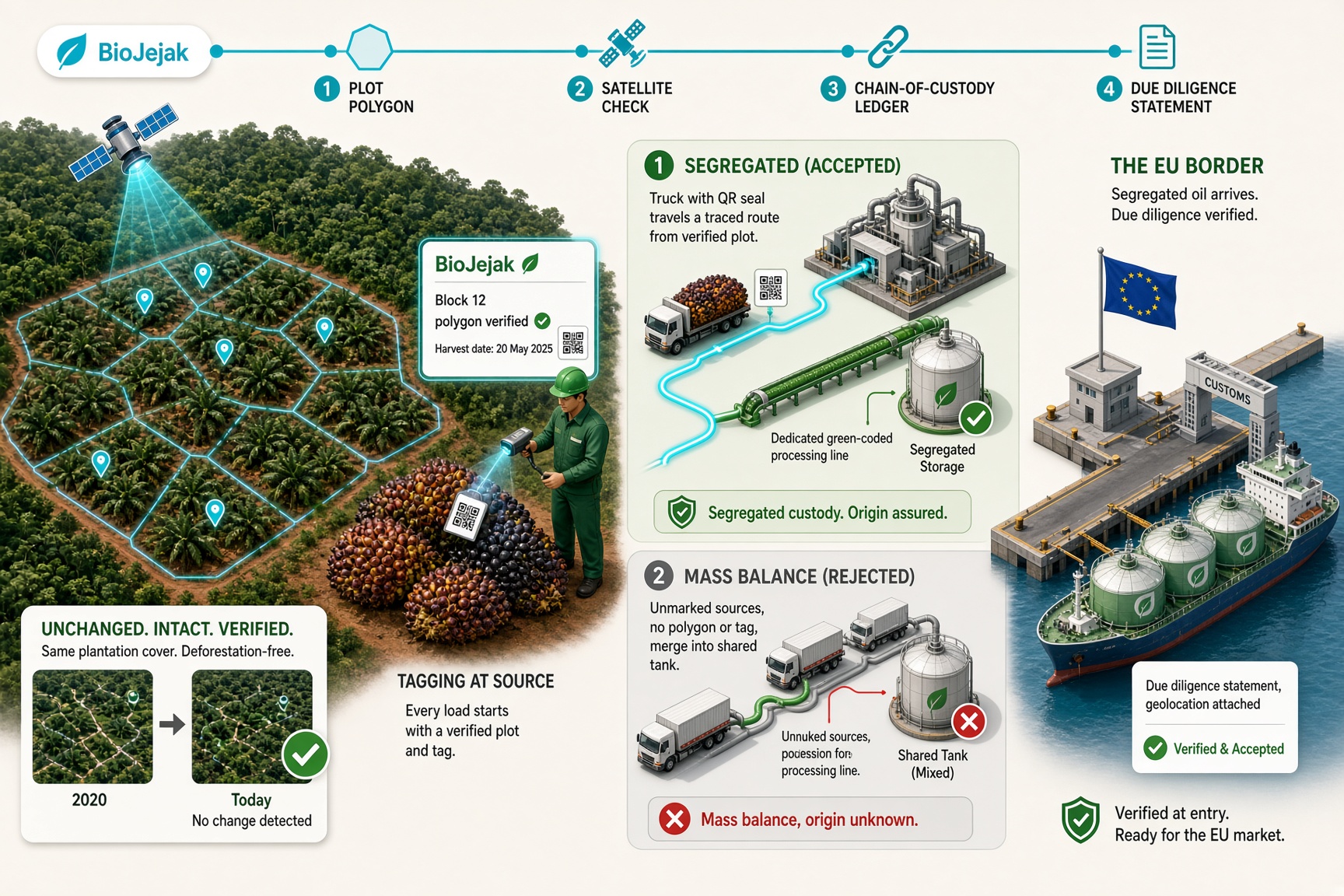
EUDR due diligence fails at the first mile, not at the border. The regulation needs plot geolocation, a deforestation-free status tied to a date, and an unbroken custody record from that plot to the shipment, and none of that can be reconstructed after the fact from declared paperwork. BioJejak records it as it happens.
- Block-level harvest tags. Each load is tagged at the estate block it came from, which is the geolocated origin EUDR asks for, as a polygon where the plot is above 4 hectares.
- Segregated custody. Append-only hand-off records keep certified-origin material separate from material of unknown origin, so claims rest on segregation rather than mass balance, which EUDR does not accept.
- Deforestation-free evidence. The block record carries the land-status basis against the cut-off date, the same evidence the certification schemes need against their earlier 2008 cut-off.
- Due diligence exports. The custody chain exports as a due diligence pack an operator can lodge and an auditor can sample, so the record is reconciled once and reported into each system.
BioJejak does not issue the due diligence statement. It holds the first-mile evidence underneath it, so the operator placing palm oil, wood or biochar on the EU market can defend the claim at audit. First mile to the border, on one record.
Sources
- Regulation (EU) 2023/1115 (EUDR), including Annex I, EUR-Lex
- Deforestation Regulation implementation, European Commission
- EUDR requirements for wood (CN 4401 and 4402), ComplianceGate
- July 2026 delegated regulation and product scope, Coolset
- ISCC CORSIA sustainability requirements (1 January 2008 land cut-off), ISCC
- VCS Methodology VM0044 for biochar, Verra