Accelerated depreciation is not green policy
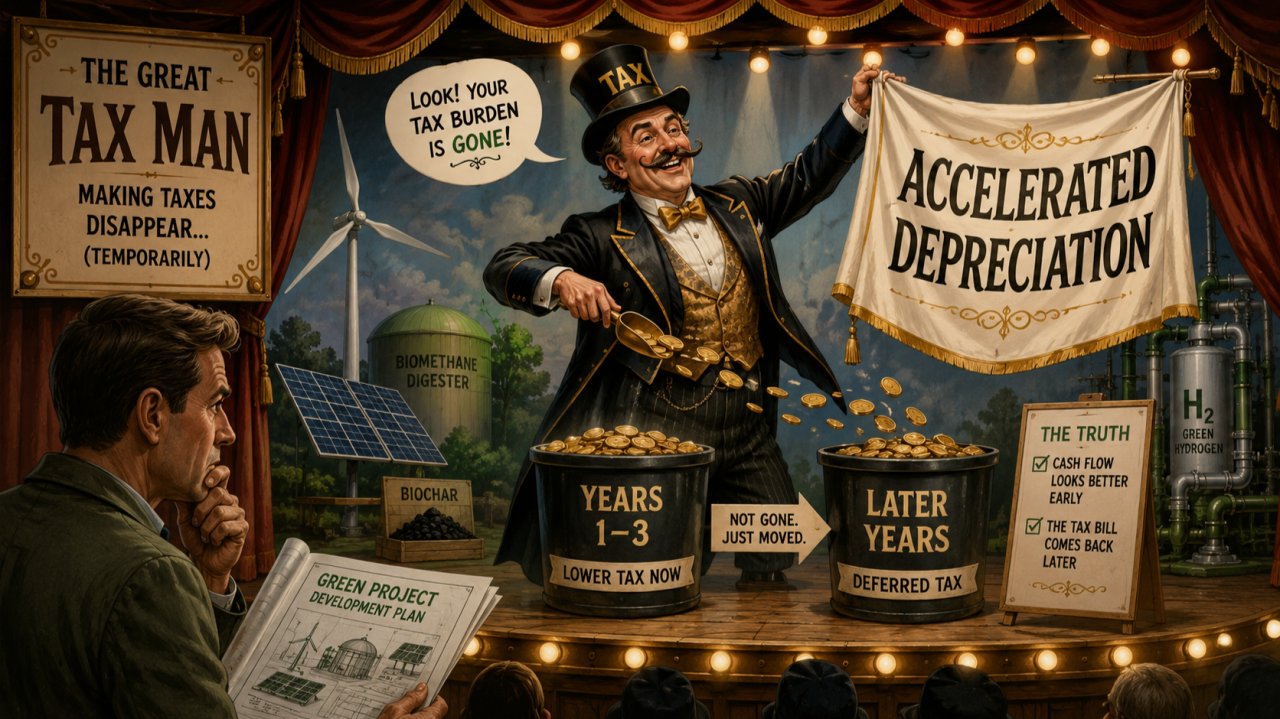
Every few months some government here and there rolls out a press release announcing "enhanced" or "accelerated" depreciation allowances for renewables, biomethane, biochar, hydrogen, energy efficiency — pick your buzzword. Ministers and bureaucrats stand at podiums. The word "support" gets used a lot.
It is theatre.
Let's be clear about what accelerated depreciation actually does. It lets the project company write the asset down faster, so taxable income is lower in the early years and less corporate tax is paid up front. Early cash flow looks better on the model.
That's it. That's the whole gift.
Because accelerated depreciation does not remove the tax burden. It moves it. The tax you don't pay in years one, two and three doesn't vanish — it lands on you later as a deferred tax liability. The government hasn't subsidised anything. It has let you pay the same tax slightly later and then called it climate policy.
And here is the part politicians are betting you won't notice: deferring tax does almost nothing for whether a green project actually gets built.
Green infrastructure is capital-intensive and financially marginal. A biomethane plant, a renewable fuel facility, a biochar operation, a waste- to-energy project — these carry real, risk: permitting, grid connection, feedstock supply, construction cost inflation, offtake risk, technology risk, digestate and residue management, carbon-credit uncertainty, and decades of operating performance you're underwriting on day one.
For a project like that, the question that decides whether it lives or dies is not "can we shave some tax off the first three years?"
The question is: does this policy improve the lifetime economics enough to make the thing bankable?
Accelerated depreciation fails that test. Routinely.
Worse, it actively misleads. It dresses up a financial model with stronger early dividends and prettier first-year debt-service cover, then quietly hands the tax bill back once the shield runs out. The underlying asset is exactly as marginal as it was before. That isn't support. It's a way for a treasury to claim it backed clean energy without spending a cent of real money.
If a government were serious, it would reduce the actual tax burden on qualifying green income — not reschedule it.
Italy, for all its other faults, actually shows what serious looks like. Under the incentive structures used for agricultural biogas and biomethane, the treatment has been far more meaningful than a depreciation gimmick: in some cases only a portion of feed-in-tariff and environmental-credit revenue is treated as taxable before operating expenses are even deducted. That shrinks the taxable base. It improves post-tax returns across the project's whole life — not just the years the accountants like.
That is a fundamentally different policy, because it changes the answer to the only question that matters.
The same logic applies to reduced VAT on renewable-energy equipment and installation. Cutting the VAT rate lowers the upfront capital burden — it helps before the money is spent, which is when projects actually need help. Far more useful than generously "accelerating" deductions after you've already written the cheque.
If a government genuinely wants green infrastructure built, the tools that work are well known and unglamorous:
lower taxation of qualifying green project income; reduced VAT on eligible capital equipment and installation; direct investment grants;
production-based tax credits; feed-in tariffs or contracts for difference; bankable green-gas, renewable-fuel or carbon certificates;
or a clean exemption from the specific taxes that would otherwise sink the project.
These change whether a project is viable. Accelerated depreciation changes when you file. One is industrial policy. The other is a calendar.
So a warning in three directions;
To policymakers: stop presenting tax deferral as if it were financial support. It isn't, you know it isn't, and the developers you claim to be helping can read a cash-flow model. Announcing accelerated depreciation and walking away is not a green industrial strategy — it's a substitute for having one.
To investors: when a project model shows suspiciously strong early dividends, look harder. You may be looking at a temporary tax deferral
wearing the costume of a stronger asset. Bankability comes from durable economics — secure revenue, manageable capex, stable opex, reliable feedstock, credible offtake, and a tax framework that improves the project over its entire life.
To developers: Don't bother claiming the accelerated depreciation allowance, its not worth the paper its written on. In the early years when a project is paying off debt and the depreciaiton allowance applies, there wont be any dividends anyway. What is worse is that in later project years, there is less plant value to depreciate and tax liabilties will be even higher.
---
Sources: European Commission Clean Energy for EU Islands (Italy VAT reduction on renewables); IEA Bioenergy, Implementation of Bioenergy in Italy – 2024; KPMG, Taxation of Renewable Energy 2025; CMS, "Can taxes save the planet?"; OECD, Italy 2023 Energy Policy Review; ECCO Climate, Energy Taxation and Fossil Fuel Subsidies in Italy (2025).
Comments
No comments yet.