The pattern behind two Australian green energy failures
Energy Renaissance: Australia’s Battery Manufacturing Capability Reaches Zero August 2025: Energy Renaissance enters administration — eliminating Australia’s only domestic lithium-ion battery manufacturer.
At its peak, the Tomago facility produced over 100,000 batteries per year, designed specifically for Australian conditions. Yet it could not compete with Chinese imports priced 30–40% lower.
The paradox is stark: Australia supplies ~52% of the world’s lithium, yet cannot sustain a single commercial battery manufacturer.
The policy gap was not a lack of intent, but a lack of market design. Government support existed in principle, but no local content requirements in renewable energy or grid-scale storage projects meant no captive domestic demand.
The outcome was predictable: equipment liquidated, 50 skilled workers laid off, and Australia’s domestic battery manufacturing capability reduced to zero.
The Common Thread
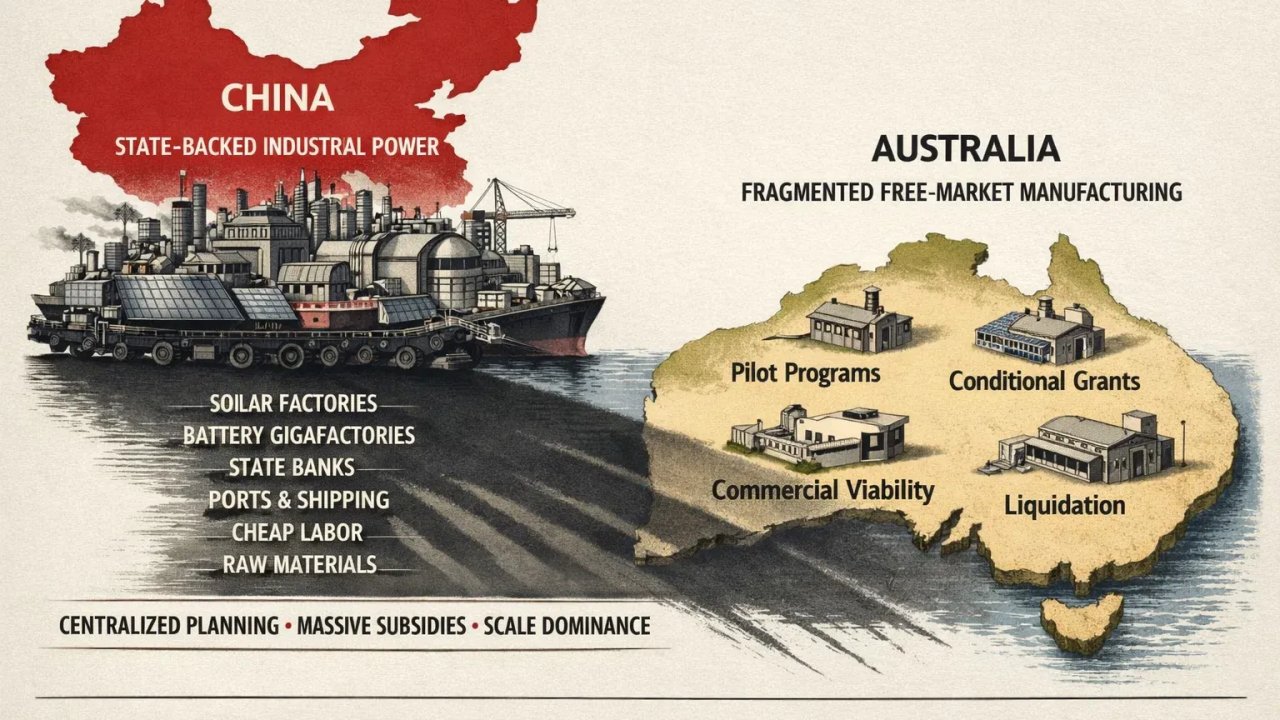
Free Markets Cannot Compete Against State-Backed Capitalism at Scale Energy Renaissance (batteries) and Vast Renewables (green methanol, AU$355 million in government support) failed for similar reasons.
The Chinese model is built on:
State-directed finance
Protected domestic markets
Subsidised energy and inputs Vertically integrated supply chains
Decade-long investment horizons tied to energy security
The Australian model relies on:
Conditional grants contingent on private capital
Open exposure to state-subsidised imports
No guaranteed offtake or procurement Quarterly profitability expectations
The result is a recurring pattern:
Strategic industry identified → government support announced → exposure to global price competition → private capital withdraws → liquidation.
The uncomfortable reality is this: Free mark economies cannot compete with Chinese state capitalism using grants and rhetoric alone.
What Might Actually Work If Australia genuinely wants sovereign clean-energy manufacturing capability, it requires at least some of the following:
Temporary import protection Guaranteed government procurement and offtake Enforced local content mandates
Direct state equity participation in strategic manufacturing
Without structural market protection, “sovereign capability” remains a press release, not an industrial outcome.
Until then, expect more announcements — and more administrators.
Comments
No comments yet.