Closing the biochar gap
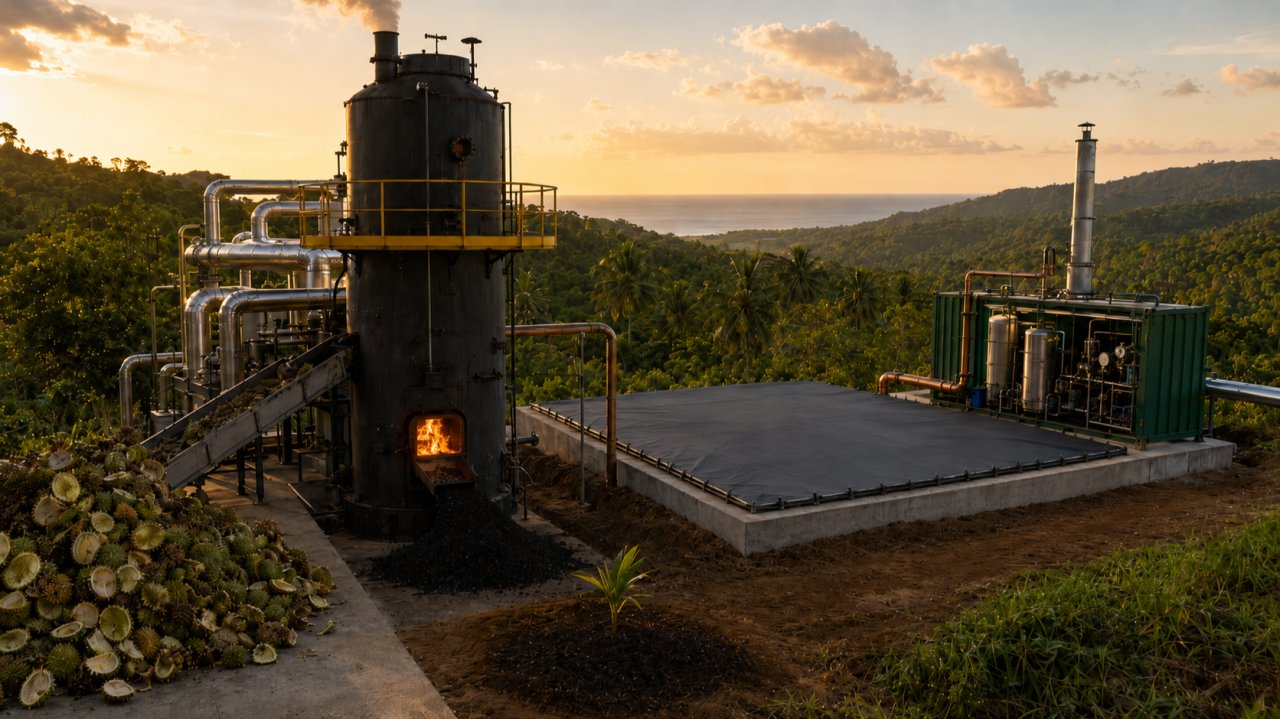
Part 2 of a series — turning pyrolysis from a single-product process into a three-stream bio-refinery on durian husk.
Part 1 of this series ended on an uncomfortable conclusion: biochar produced from purchased wood pellets is roughly 45× too expensive to pay for itself on carbon credits alone at the EU ETS benchmark (~€75/t CO₂). Closing the gap requires two things: cheaper feedstock, and additional revenue from what the single-product model treats as waste.
This article looks at one way to do both — by building the pyrolysis plant as an integrated bio-refinery on durian husk, an abundant, low-cost agricultural waste across Southeast Asia.
The Bio-Refinery Concept Pyrolysis is rarely just a biochar process. Every kilogram of biomass produces three product streams:
• Solid biochar — for soil amendment and durable carbon sequestration.
• Liquid condensate — wood vinegar and bio-oil, dominated by the bio- oil organic load.
• Non-condensable gas — low-quality wood gas that becomes combustible when preheated and recirculated to the heat source.
In the single-product framing, the liquid is a disposal liability and the gas is vented. In the integrated bio-refinery, the liquid is anaerobically co- digested into biogas, and the gas drives the process.
Case Study: 3 t/h Dried Durian Husk The plant: 3 tonnes per hour of dried durian husk (≈10 % residual moisture) into a slow-pyrolysis reactor at 500 °C — the peak bio-oil regime per published mass balances for durian shell (Hu et al. 2024).
Stream / Per hour
Dried husk feed 3,000 kg
Biochar (34 % of dry feed) 924 kg
Liquid condensate to anaerobic digestion ~1,400 kg
Non-condensable gas (process heat) 680 kg
Headline Numbers Biogas from anaerobic digestion. The liquid condensate carries a COD load of ~1,200 kg O₂/h, derived from the bio-oil's elemental composition. Long-residence in-ground digesters routinely outperform short-HRT lab numbers; at ~70 % effective conversion the AD step delivers:
Biogas output / Value
Continuous methane production ~296 m³ CH₄/h
Annual methane (8,400 op hours) ~2.5 million m³ CH₄/year (Equivalent to ~240 MMBtu/d)
Annual energy (thermal equivalent) ~92,800 GJ/annum
Biochar carbon. At conservative permanence assumptions (65 % C in char, 70 % stable carbon fraction):
Biochar carbon / Value
CO₂-equivalent sequestered ~1.5 t CO₂-eq/h
Annual biochar produced ~7,800 t/year
Annual CO₂-eq sequestered ~13,000 t/year
Three Revenue Streams Instead of One Indicative gross revenue from the integrated plant, before feedstock and operating costs:
Revenue stream / Indicative annual
Biochar product (industrial grade, €300/t) ~€2.3 M
Carbon credit revenue ( €8.6/t CO₂-eq) ~€0.1 M
Biomethane value (€10/GJ) ~€1.0 M
Indicative gross revenue total ~€3.4 M / year
Next Steps This is a concept sketch using literature-derived yields and a generic 3 t/h scale. Real-site numbers depend on feedstock availability, biogas off-take agreements, regulatory framework, capital structure, and the integration design between the pyrolysis, condensate handling, and AD trains.
If you would like to discuss developing this concept for a specific site or feedstock, get in touch:
Comments
No comments yet.