Soil amendment: biochar
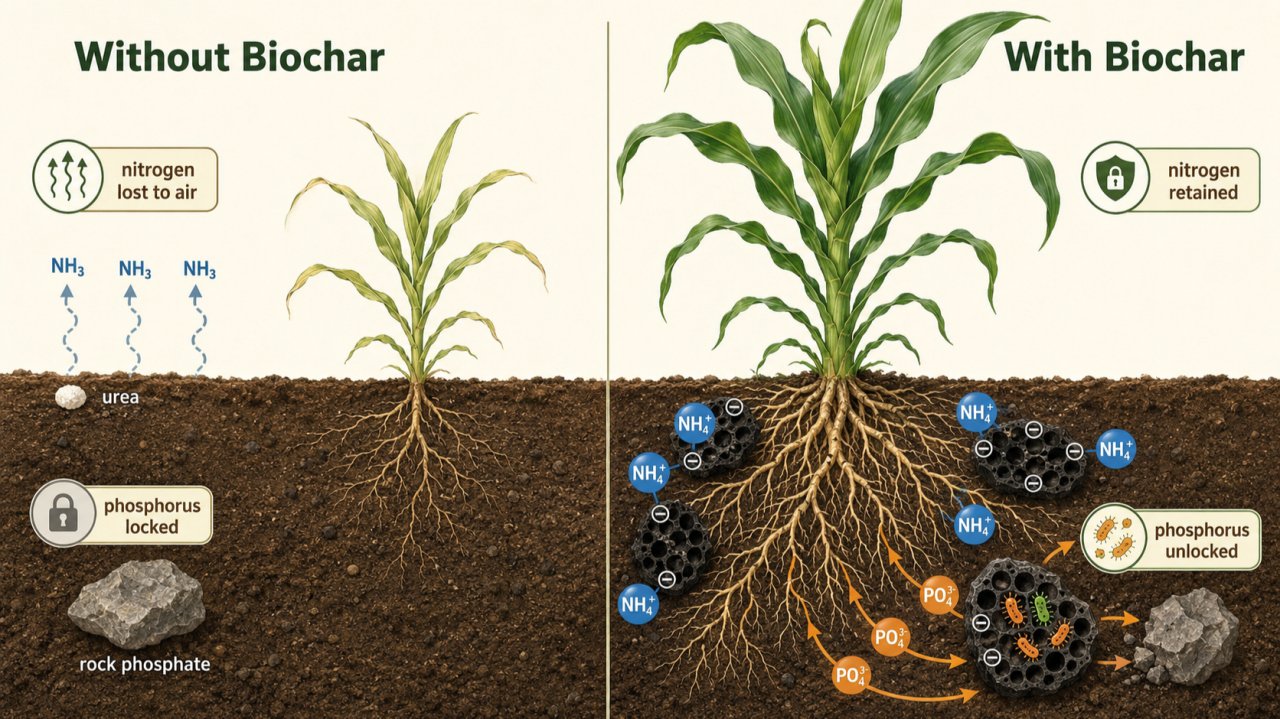
Biochar is made by heating organic matter without oxygen (pyrolysis), it leaves behind a porous, carbon-rich skeleton with enormous surface area and a high cation exchange capacity (CEC) — the ability to hold positively charged nutrient ions on its negatively charged surfaces and release them slowly. That single property lets biochar plug the two biggest leaks in conventional fertilizing: nitrogen lost to the air from urea, and phosphorus locked away in rock phosphate.
Reducing ammonia volatilization When urea hits moist soil, the microbial enzyme urease rapidly hydrolyses it to ammonia (NH₃). That ammonia dissolves into soil water, raising the local pH and sitting in equilibrium with its dissolved, alkaline form, ammonium (NH₄⁺). Two fates then compete for that nitrogen. The outcome you want is for nitrifying soil bacteria to oxidise the dissolved ammonium into nitrate that plants can take up. But in warm, poorly buffered conditions, the equilibrium tips back toward ammonia gas, which volatilizes and floats away — and because the dissolving ammonia itself drives the pH up, it accelerates its own escape. Volatilization claims roughly half of the nitrogen applied — an expensive leak that also pollutes air and water.
This is also why applying urea to laterite clay soils is a poor decision. Laterites are highly weathered tropical soils dominated by kaolinite and iron and aluminium oxides, which leaves them with very low CEC and almost no buffering capacity. With little exchange surface to hold the ammonium and nothing to absorb the pH spike from urea hydrolysis, they tick every box that drives volatilization — warm, poorly buffered, and unable to retain what they can't hold. The problem is physical as much as chemical: these clays are typically compact, water-saturated, and capped with little or no topsoil, so they have almost no pore space to absorb a dissolved granule. Surface-applied urea therefore barely penetrates — it sits fully exposed to the air during hydrolysis, the worst possible position
for volatilization, while the next rain or the standing water already present washes much of it laterally off the field as runoff. Between volatilization, runoff, and negligible CEC, very little of the applied nitrogen ever reaches a plant. These are precisely the soils where biochar earns its keep: it supplies the exchange capacity and pH buffering the native clay lacks, and as a structural amendment it lowers bulk density and opens pore space, improving the infiltration and water-holding that compaction has destroyed.
Biochar's negatively charged surfaces grab ammonium ions and hold them in place, keeping nitrogen in the dissolved NH₄⁺ form — available to nitrifying bacteria and plant roots rather than escaping as NH₃ gas. Its porous structure adds a second line of defense: it buffers the pH rise and soaks up moisture and dissolved nutrients, both of which suppress the conditions that drive ammonia loss. The result is more of your purchased nitrogen reaching the root zone, and a longer feeding window from a single application.
Unlocking phosphorus from rock phosphate Rock phosphate is cheap and abundant, but its phosphorus is bound in insoluble mineral form. It only becomes plant-available when acids and microbes slowly dissolve it — a process that in bare soil takes around 5 years.
Biochar accelerates this on two fronts. Its porous, high-surface-area structure acts as a microbial habitat, sheltering the phosphate-solubilizing bacteria and fungi that secrete the organic acids doing the actual dissolving. At the same time, its CEC surfaces continuously mop up the calcium and other cations released as the mineral breaks down. By pulling those cations out of solution, biochar keeps pushing the dissolution reaction forward instead of letting it stall at equilibrium — the same principle that drives any reaction toward completion when you remove its products. The freed phosphate is then held loosely on the biochar and metered out to roots over time, rather than re-locking into new insoluble compounds.
The takeaway Biochar's value isn't that it feeds plants directly — it's that it makes every other input more efficient, holding nitrogen against volatilization loss and hosting the microbes that unlock rock phosphate, while metering both out slowly.
Comments
No comments yet.