Biochar briquettes for European steel
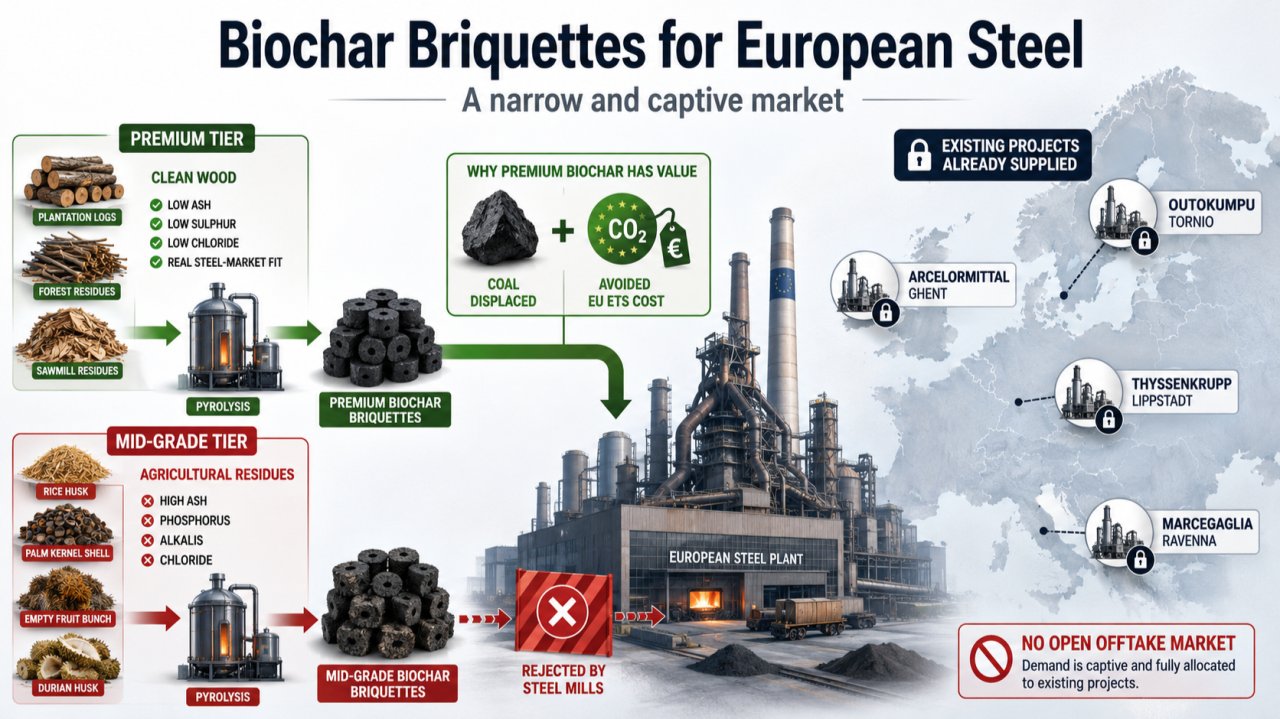
Part 4 of a series — only one biochar tier is sellable to steel mills, the feedstock for it is contested, and every active European project is already supplied. There is no open offtake market.
Compared against Rotterdam thermal coal alone (~€120 per tonne in May 2026), biochar briquettes look uncompetitive. The honest comparison adds the EU Emissions Trading System (EU ETS) allowance the steel mill avoids when it swaps fossil carbon for qualifying biomass carbon. At EU emission allowance (EUA) prices around €80 per tonne of CO₂ this changes the picture — but only inside a narrow specification window, and the European buyer set for that window is already supplied.
The Two Value Components Every tonne of fossil carbon oxidised in steelmaking generates 3.667 tonnes of CO₂. At €80 per tonne EUA that is €293 of avoided carbon liability per tonne of fossil carbon displaced. Free allocation of allowances does not erode this marginal value — a freed allowance can be sold for the full EUA price. Add the displaced coal commodity (~€120 per tonne thermal coal, higher for coking or pulverised-coal-injection grades) and the per-tonne biochar value depends on carbon content and substitution efficiency.
The Coking-Coal Benchmark Hard coking coal as received: roughly 76% total carbon, 8–10% ash, 0.5– 0.7% sulphur, 0.05–0.15% chloride, phosphorus below 0.05%. This is the specification a biochar substitute is held against.
Two Biochar Tiers by Feedstock
Premium tier — clean wood pyrolysed at above 550 °C: 78–85% total carbon, 1–4% ash (silica and calcium dominated), less than 0.05% sulphur, less than 0.02% chloride, less than 0.5% alkalis (sodium and potassium). Cleaner than coking coal on every contaminant axis.
Mid-grade tier — agricultural residues (rice husk, palm kernel shell, oil- palm empty fruit bunch, durian husk): 60–72% total carbon, 8–15% ash (rice husk can reach 20%), 0.1–0.3% sulphur, 0.05–0.20% chloride (empty fruit bunch and some palm streams reach 0.3–0.6% without washing), 1– 5% alkalis, plus 0.1–0.5% phosphorus.
Biochar Quality for Steel Steel mills do not buy biochar because it is biogenic. They buy it because it saves on ETS costs and be substituted into a furnace without damaging the steel chemistry, the refractory or the slag. Agricultural-residue biochar fails on four mill-rejection barriers:
• Phosphorus contamination of steel chemistry — 0.1–0.5% phosphorus in agricultural-residue char is hard to remove from the melt and degrades mechanical properties.
• Alkali attack on refractory — 1–5% potassium and sodium drives refractory wear and alkali-chloride circulation in the blast furnace.
• Chloride and dioxin risk — even 0.05–0.20% chloride drives corrosion and dioxin formation in pre-reduction; high-chloride feedstocks (empty fruit bunch) are non-starters without expensive washing.
• Supply consistency — agricultural residues are seasonal, geographically dispersed, and hard to deliver at the multi-thousand-tonne specification consistency a steel mill demands.
These barriers are not commercial; they are technical. Steel mills will not qualify mid-grade biochar at any price, because it will damage the asset. The mid-grade tier therefore has no realistic value into European steel.
Only the premium tier is a real product for this buyer.
Premium Tier — Price Build-Up Per tonne of premium biochar at 80% total carbon (1 tonne biochar ≈ 1.05 tonnes thermal-coal-equivalent):
• Coal commodity displaced: 1.05 × €120 = €126
• Avoided emission allowance: 0.80 × 3.667 × €80 = €235
• Theoretical maximum: €361
• less substitution efficiency (95%), handling, certification: −€33
Realistic price into European steel: €310–340 per tonne biochar.
Why the Premium Tier's Feedstock Economics Are Tight Premium biochar needs clean wood. Under the EU Deforestation Regulation (covered in Part 3 of this series), the defensible source is plantation forestry — and that is where the feedstock problem starts. There are three places to get clean wood, and they are already contested:
• Plantation roundwood — pulp and paper, construction lumber, and bioenergy already pay €80–400 per cubic metre depending on grade. Biochar conversion cannot outbid these buyers.
• Forest residues (slash, tops, branches) — low collection density and high logistics cost. Increasingly retained on site for soil health under Forest Stewardship Council and Programme for the Endorsement of Forest Certification standards. Where collected, the residues feed wood-chip and pellet markets that already pay €40–80 per tonne.
• Sawmill and processing residues — typically already utilised: kiln-drying boilers, in-house heat and power, pellet feedstock, medium-density fibreboard and particle board. A biochar producer must outbid the existing user.
Add pyrolysis cost (~€100–200 per tonne of output) and briquetting cost (~€30–50 per tonne) to a feedstock cost of €50–150 per tonne and the all- in production cost lands at €180–400 per tonne — overlapping the realistic price band of €310–340 per tonne. The margin exists but is thin and only feedstock-secure operators capture it.
European Projects — There Is No Open Offtake Market Every active European biochar-for-steel project is already supplied. There is no open tender for a third-party supplier to bid into.
• ArcelorMittal Ghent — Torero (Belgium): 37,500 tonnes per year of bio- coal commercial since December 2023; target 350,000 tonnes per year. Supplied through an on-site Perpetual Next-licensed torrefaction plant — captive.
• Outokumpu Tornio biocoke (Finland): €30 million pelletizing plant operating since mid-2025. Supplied by Envigas, in which Outokumpu holds a 20% strategic stake — captive.
• ThyssenKrupp Rothe Erde Lippstadt (Germany): captive premium biochar from on-site waste-wood pyrolysis — wholly internal.
• Marcegaglia AdriatiCO₂ (Ravenna, Italy): not really a biochar offtake at all. It is an EU ETS Innovation Fund demonstration of integrated decarbonisation — biochar plus biomethane as the reducing agents in a Direct Reduced Iron pilot, with the resulting process CO₂ captured and injected into depleted offshore gas fields in the Adriatic.
The takeaway is uncomfortable but worth stating plainly: for a third-party biochar producer — particularly one working from agricultural residues or non-European feedstock — there is essentially no addressable European steel offtake market.
Wider Limits Worth Naming • There is no mandate. No regulation requires steel mills to buy biochar.
• No double carbon credit. Carbon entering a steel furnace is re-emitted, so there is no Carbon Dioxide Removal credit available to the producer. The choice is steel-market revenue or soil-amendment plus removal-credit revenue (~€250–400 per tonne total), not both.
• Scrap-based electric arc furnace on renewable electricity competes. A scrap-fed electric arc furnace needs only 12–24 kilograms of carbon per tonne of steel — a much smaller market than primary blast furnace or Direct Reduced Iron steelmaking.
• Green hydrogen Direct Reduced Iron competes. Plants like Stegra (Sweden) and ThyssenKrupp's tkH₂Steel (Duisburg) replace fossil coal with hydrogen.
Closing The biochar-for-steel use case in Europe is real, but for almost every external producer it is closed. The mid-grade tier from agricultural residues has no steel buyer at all on technical grounds. The premium tier from clean wood has a real specification fit but a thin margin and contested feedstock. And the four named European projects do not host an open commercial offtake — three are captively supplied and the fourth is an EU- funded CCUS demonstration that pairs biochar with biomethane and offshore CO₂ storage.
For producers working with agricultural residues — durian husk, rice husk, empty fruit bunch, palm kernel shell — the steel route is not the answer.
Next Steps To discuss where a specific feedstock and supply chain actually fits in the global market, get in touch:
Comments
No comments yet.