Biochar from wood pellets: a production snapshot
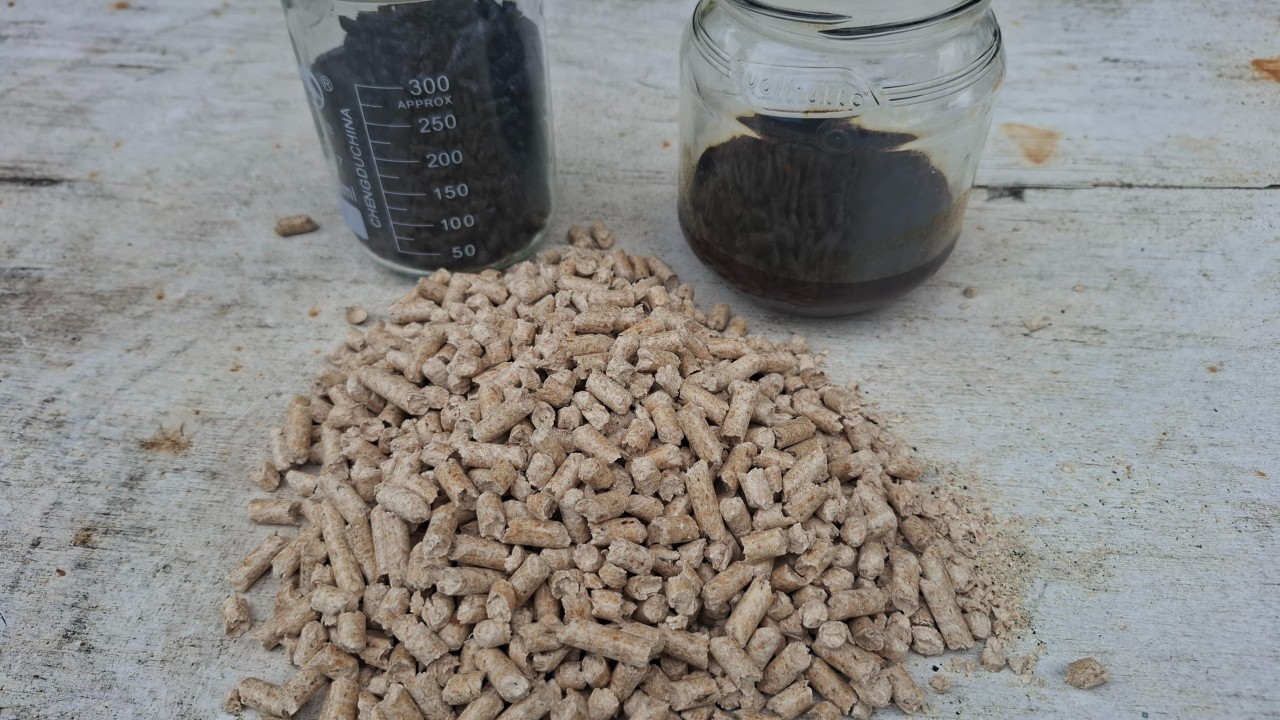
This first article puts real numbers on a single batch of biochar produced in a small tube furnace: what goes in, what comes out, and what each gram of feedstock yields.
The Setup A single batch was run in a small tube in tube furnace, internally heated by a wood fire. Wood pellets sat inside the sealed inner steel tube and pyrolyzed in the absence of oxygen for 40 minutes. The endpoint was determined by the cessation of wood-vinegar condensation. Volatile vapors were drawn off and condensed; the non-condensable gases were vented past the condenser and tested.
Feedstock: MM Royal wood pellets, ENplus A1 certified, fir and pine. 8% moisture, 0.4–0.5% ash, calorific value 4.9 kWh/kg, bulk density 600–750 kg/m³.
Inputs and Outputs Pellets in (as-received) 349.5 g
External fuel consumed (chopped dry pine) 1,549 g
Biochar out 97.3 g
Wood vinegar condensed 114.8 g
Gases and losses (by difference) 137.4 g
Closure: 349.5 g in, 212.1 g identified out, 137.4 g unaccounted (39.3 %) — the non-condensable gases and minor system losses.
A note on the off-gas (pyrogas): the gas leaving the condenser was tested and found to be non-combustible. This is consistent with the well-known fact that wood gas is a low-quality fuel.
Per-Unit Yields Normalizing to one kilogram of as-received pellet input:
Output (per kg of pellets in) Yield
Biochar 278 g
Biochar bulk volume 858 mL
Wood vinegar 328 g
Gases and losses 393 g
CO₂-equivalent sequestered (conservative) ~570 g
On a dry-pellet basis, the biochar yield is 30.3 % — in the upper half of the typical slow-pyrolysis range of 20–35 %. Estimated carbon retention from feedstock to solid char is approximately 48 %, with the balance leaving as condensate and off-gas.
The biochar measured 324 kg/m³ in bulk density, roughly half the pellet density of 600–750 kg/m³. Paired with a 72 % mass reduction, that density loss is the porosity gain — the surface area and pore structure that make biochar useful as a soil amendment, filtration medium, or carbon scaffold.
Economics: Production Cost and Carbon Credits Pellets cost €5.60 per 15 kg, including 22 % IVA — €0.37 per kg as paid, or €0.31 per kg ex-IVA. The external fuel (chopped dry pine) is priced here at the same per-kg rate, since it comes from the same wood-fuel market. The wood-vinegar co-product is treated as zero-value.
Cost basis (incl. IVA) Value
Pellets per batch (349.5 g) €0.13
External fuel per batch (1,549 g) €0.58
Total raw material per batch €0.71
Per kg of biochar produced €7.29
Per tonne CO₂-eq sequestered (~200 g/batch) ~€3,540
For a price benchmark, the EU ETS allowance traded at roughly €75 per tonne CO₂ in May 2026. At ~€3,540 per tonne, this batch is roughly 45× too expensive to break even at that benchmark.
Three Takeaways A 30 % dry-basis biochar yield with ~48 % carbon retention is a solid baseline. The pellet feedstock behaves predictably and produces a dense,
well-structured char.
The pyrogas does not flare directly. Recovering its energy means preheating and recirculating it back through the fire — not burning it at the condenser outlet.
At the EU ETS benchmark (~€75/t CO₂), this batch's implied carbon cost is ~45× too high. The carbon-credit case for biochar is not imaginary, but it is often overstated. Biochar credits are not EU ETS allowances, and using EUA prices to justify biochar production is not bankable. The base case should stand on product value, avoided disposal cost, soil/agronomic benefit, heat value, or contracted removal offtake — not assumed ETS revenue.
Comments
No comments yet.