Inflated biogas covers and lightning risk
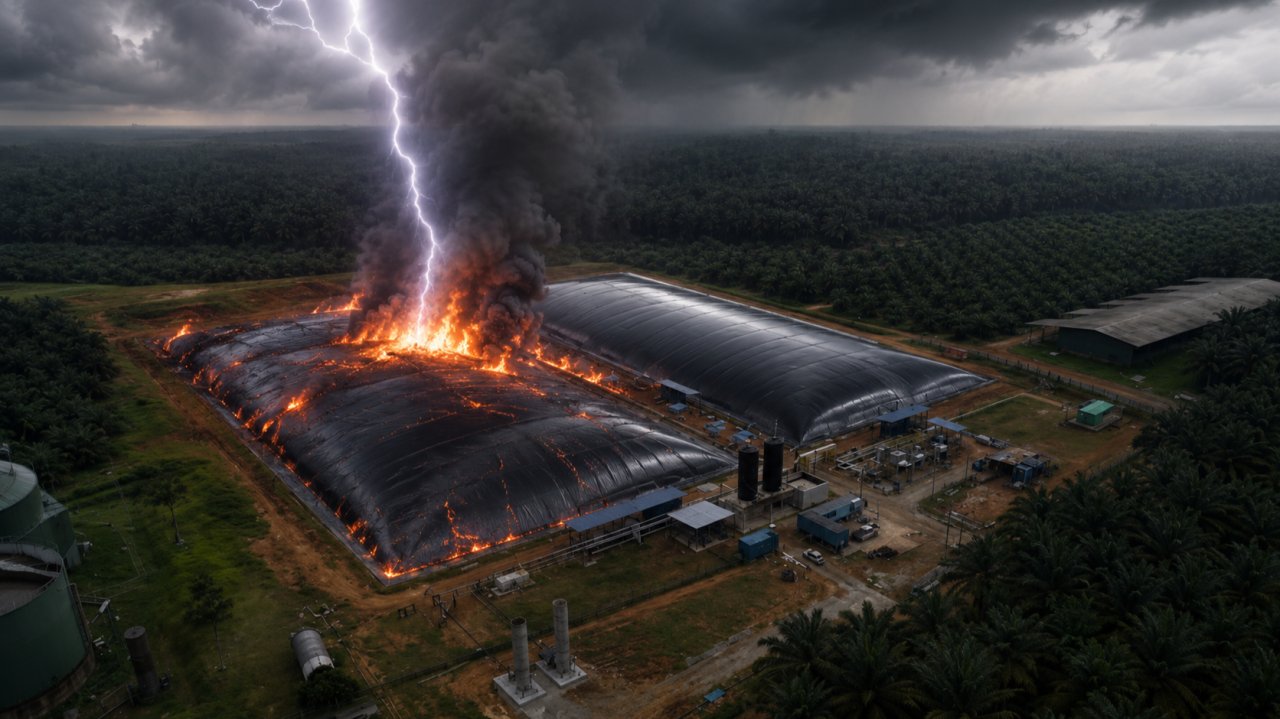
Inflated membrane covers are commonly used on anaerobic digesters and biogas lagoons because they are relatively low cost, quick to install and can provide gas storage directly above the digestate.
But in tropical regions with high lightning exposure, they can introduce a risk that is often underestimated.
The issue is not simply that lightning can damage a membrane.
The more serious concern is the combination of design features that can exist at the highest point of the digester:
A large gas-filled inflated cover. A metallic pressure relief or gas release vent located on top of the cover. A hazardous area where excess biogas may be released.
A storm environment with frequent lightning activity.
That combination can create a credible ignition scenario at exactly the worst location on the asset.
In other words, the plant may unintentionally place a metallic fitting and a gas release point at the highest and most lightning-exposed part of a flexible gas-filled structure.
That is not a minor detail. It is a design risk.
A Malaysian biomethane digester suffered a lightning-related fire in late 2023 after only a short period of operation. Its not there first time this type of incident has occured and are never publicised in detail. Bad news does not make it into sales brochures, lender presentations or supplier references.
But from an insurer, lender or asset-owner perspective, these events matter.
A biogas project does not need a complicated process failure to lose revenue. One fire on the cover can take the gas system offline, interrupt biomethane supply, trigger repair costs, damage confidence, create contractual issues and stop the project generating revenue.
For BOO, BOOT and project-financed schemes, this is a critical issue.
The lender and insurer are not only asking whether the plant can make gas. They are asking whether the asset can survive credible site hazards and continue producing revenue. If the cover is a known weak point, the business interruption exposure may be far larger than the replacement cost of the membrane.
This is where a low-cost cover can become very expensive.
The key questions should be asked before the plant is built, not after a fire:
Is the top of the cover the highest exposed point of the plant? Is there a metal vent, relief device or instrument mounted on top of the cover?
Can biogas be released from that location? Has the hazardous area classification considered this release point properly? Has the lightning risk been assessed for the actual installation, not just the generic datasheet? Are all metallic fittings, pipework, handrails, vents and instruments bonded and earthed correctly?
Is there a properly engineered lightning protection system? Are flame arrestors, gas detection, emergency shutdown logic and pressure relief arrangements fit for purpose? Has the insurer reviewed the actual design, or only the equipment schedule? Has business interruption been modelled, or only physical damage replacement cost?
There is also a more serious issue that is often ignored until something goes wrong: personal safety and potential liability.
If a fire or explosion involving a gas-filled digester cover resulted in the death of an employee, contractor or emergency responder, the matter would not remain a simple insurance claim. It could become a workplace- fatality investigation.
The questions then become much more difficult:
Who approved the design? Was the lightning risk foreseeable? Was the hazardous area classification adequate?
Was the vent location appropriate?
Were safer design alternatives considered? Were operators trained for this scenario? Was the plant reasonably safe to operate?
At that point, the discussion moves from “the cover failed” to “who accepted this risk?”
That is why I do not design plants around inflated gas covers where the cover itself becomes the highest and most exposed point of the facility.
My preferred approach is a flat-cover digester design.
With a flat cover, there is no metallic gas release vent located on top of an inflated membrane. The cover is not treated as the highest exposed gas- venting point of the plant. The highest point of the facility can be deliberately located elsewhere, where lightning protection, bonding, earthing and hazardous-area controls can be engineered properly.
A flat cover also does not compromise biogas production. It simply removes the cover’s function as a gas storage balloon. The digester still produces biogas continuously, and flat-cover systems have been proven to operate effectively under slight vacuum, with gas drawn continuously to the downstream handling system rather than being stored above the digestate.
A flat cover reduces the likelihood that the digester cover itself becomes the preferred lightning attachment point. It also avoids combining four risk factors in the same location:
A gas-filled membrane. A metal vent. A hazardous gas release point.
The highest exposed point of the plant.
The problem is not that membrane covers should never be used. The problem is assuming they are benign because they are common.
In Southeast Asia, where palm oil mills, POME digesters and biomethane projects are often located in high-lightning-density regions, the digester cover should be treated as a major risk item, not a procurement afterthought.
For developers, mill owners, lenders and insurers, the real question is simple:
Would your insurer still be comfortable after seeing the vent location, lightning exposure, hazardous-area classification, emergency shutdown logic and business interruption scenario?
If the answer is unclear, the project risk is probably higher than the financial model suggests.
Contact me if you would like to discuss an independent risk review of your digester cover, gas handling system, hazardous-area classification or biomethane project configuration.
Comments
No comments yet.