Bio-methane contract pricing
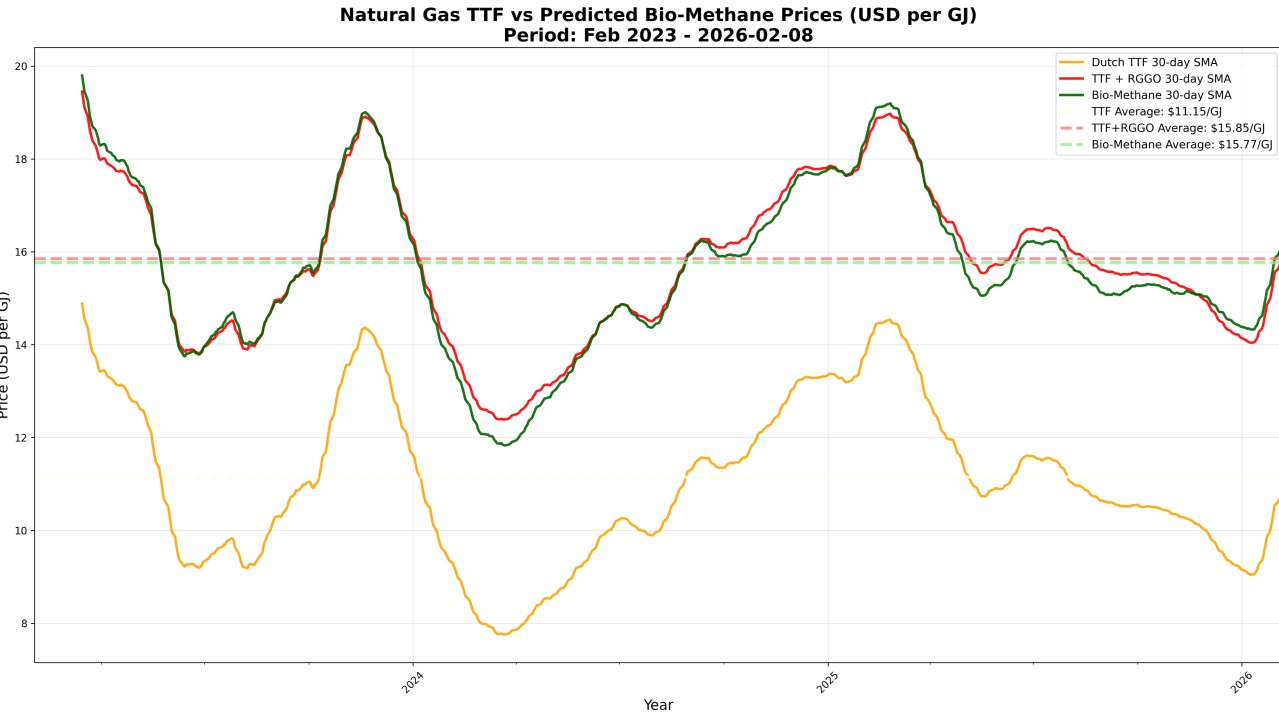
This chart analyzes biomethane pricing relative to Dutch TTF natural gas prices from 2023 onward, with the aim of understanding how biomethane prices have behaved in practice rather than prescribing how they must clear.
Over the period analysed, biomethane prices appear to track closely to TTF plus a carbon value expressed on an energy basis. When fossil gas is consumed, that carbon value is realised through the EU-ETS. When biomethane is used, the same avoided emissions value is monetised through renewable gas certificates (RGGOs). Empirically, the two instruments appear to act as proxies for one another, resulting in similar effective price outcomes.
Viewed through a contract-futures lens, this suggests a simple and transparent pricing interpretation:
Spot-indexed biomethane pricing can be approximated as:
Spot Biomethane ≈ TTF + ETS (€/MWh or $/GJ equivalent)
Fixed biomethane pricing can then be derived by averaging the same components over a defined lookback period:
Fixed Biomethane Price ≈ Average TTF + Average ETS
Using post-2023 data, this approach yields a fixed benchmark of approximately US$15.81/GJ, which aligns closely with the average biomethane prices observed over the same period. The implication is not that biomethane contracts are formally indexed this way, but that recent
pricing outcomes have behaved as if biomethane were clearing against gas plus carbon, rather than gas alone.
Framed this way, biomethane begins to resemble a composite futures product: a liquid gas index combined with a regulated carbon component. That framing helps explain the lower observed volatility in biomethane prices and provides a practical basis for discussing spot-linked or fixed- price long-term contracts without relying on discretionary “green premiums.”
Implications for Contracts for Difference (CfDs), Interpreted this way, the same framework also lends itself naturally to a contract-for-difference structure. A biomethane CfD can be defined against a reference price of TTF + ETS, with the strike price set at a fixed level (for example, the historical average of $15.81/GJ). If the realised TTF + ETS price falls below the strike, the CfD pays the producer the difference; if it rises above, the producer pays back the excess. Because RGGO values appear to act as a proxy for avoided ETS costs, this structure economically replicates biomethane pricing outcomes observed in the market while isolating producers and buyers from gas price volatility. In effect, the CfD converts fluctuating gas and carbon prices into a stable, bankable revenue stream without relying on discretionary premiums or opaque certificate pricing.
Note: US Dollar references have been used in the plot for the purposes of providing some guidance for international markets, whereas the EU-ETS, TTF and RGGO clear in Euros.
Comments
No comments yet.