Oil palm empty fruit bunches and methane emissions
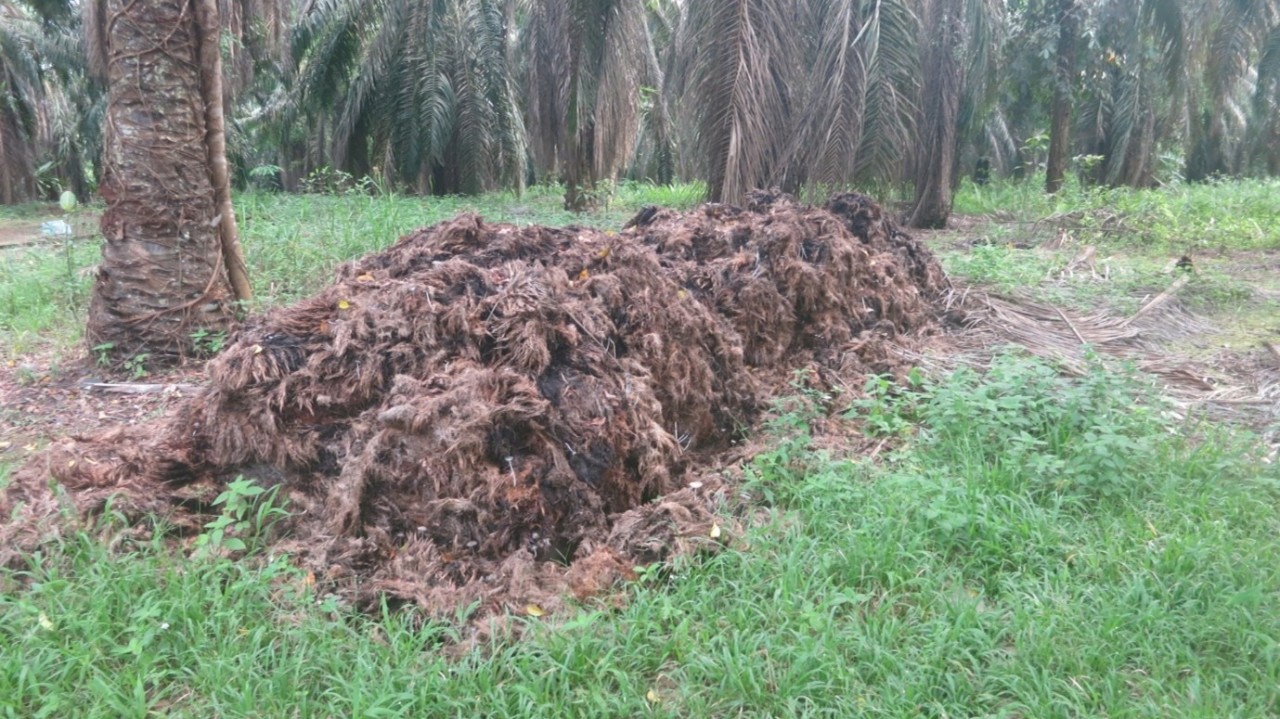
Across Indonesia and Malaysia, palm oil mills produce millions of tonnes of Oil Palm Empty Fruit Bunches (EFB) each year — a fibrous residue left after oil extraction.
Most of it is dumped in nearby fields or designated disposal sites.
Our field investigation in Kalimantan confirmed that once dumped, EFB transitions from aerobic to anaerobic decomposition within 2–3 months and generates measurable methane — up to 24,866 ppm inside decomposing piles.
After dumping in the field, decomposition follows six stages:
1. Fresh aerobic phase – steaming material, little methane
2. Fungal colonisation – high biological activity
3. Compaction phase – reduced airflow 4. Transition to anaerobic conditions (within 2–3 months)
5. Active methane generation (~9 months duration)
6. Late-stage woody residue (after 12+ months)
Methane concentrations inside piles was measured up to:
6,076 ppm in smaller windrows
24,866 ppm (2.49% CH₄) in compacted piles
This is not theoretical methane.
It is occurring in normal field dumping practices, sometimes refered to as field composting.
The Scale of the Emissions A standard 60 tonne/hour mill produces approximately 66,000 tonnes of EFB per year.
Using the UNFCCC solid waste methodology:
Field dumping ≈ 9,000 tonnes CO₂e per year per mill
Large managed waste sites ≈ 22,500 tonnes CO₂e per year per mill
Multiply this across hundreds of mills in Indonesia and Malaysia, and annual national emissions from EFB dumping reach into the millions of tonnes CO₂e.
This is a sizeable, currently unpriced emissions source.
What Happens If Carbon Pricing Is Extended to Palm Oil? Indonesia has introduced an emissions trading framework, but it currently applies primarily to coal-fired power plants.
Malaysia does not yet operate a broad carbon tax on agricultural residues.
If either government were to extend a carbon pricing mechanism to cover EFB dumping:
At €50/tCO₂e → billions in potential annual revenue
At €80/tCO₂e → materially higher fiscal receipts
For Malaysia alone, estimated EFB dumping emissions are roughly 2.5 million tonnes CO₂e annually.
At €80/t, this equates to approximately €200 million per year in potential carbon revenue from EFB alone.
Indonesia’s larger production base implies even greater revenue potential.
This is not insignificant.
It begins to resemble a new fiscal instrument.
Beyond Climate Policy: A Revenue Lever? Palm oil exporting countries already levy export duties and windfall taxes tied to crude palm oil prices.
Some policy discussions increasingly view carbon pricing on agricultural waste streams as:
A climate compliance mechanism
A pre-emptive measure against external carbon border taxes
Or a supplementary fiscal lever layered above export duties
The European Union’s Carbon Border Adjustment Mechanism currently covers industrial sectors, not palm oil — but embedded emissions scrutiny is increasing globally.
Governments face two strategic options:
1. Allow external jurisdictions to price embedded carbon via border adjustments
2. Internalise the pricing domestically and retain the revenue
From a sovereign fiscal perspective, the second option is often more attractive.
The Political Economy Reality If carbon pricing is extended to EFB dumping, the most likely outcome is straightforward: it will function primarily as a tax.
Costs will be passed through the supply chain. Mill margins will tighten. Pressure will flow upstream to growers.
Unless revenues are legally ring-fenced and transparently reinvested into methane capture, composting, or anaerobic digestion infrastructure, emissions behaviour will not materially change.
Experience elsewhere shows that carbon pricing without strict reinvestment mechanisms does not automatically drive decarbonisation — it stabilises government revenue.
In that scenario, methane pricing on palm oil waste would operate less as climate policy and more as an additional fiscal layer on a strategically important export industry.
A Turning Point for the Industry Methane from EFB dumping is:
Measurable Quantifiable Monetisable
Once something can be measured and assigned a carbon price, it becomes part of the fiscal landscape.
For Indonesia and Malaysia, this represents:
A compliance risk A decarbonisation opportunity And potentially, a significant new source of government revenue
The critical policy question is not whether methane is being generated.
It is whether governments choose to treat it as a climate liability — or as a fiscal opportunity.
Comments
No comments yet.