The ethanol-to-jet reality check
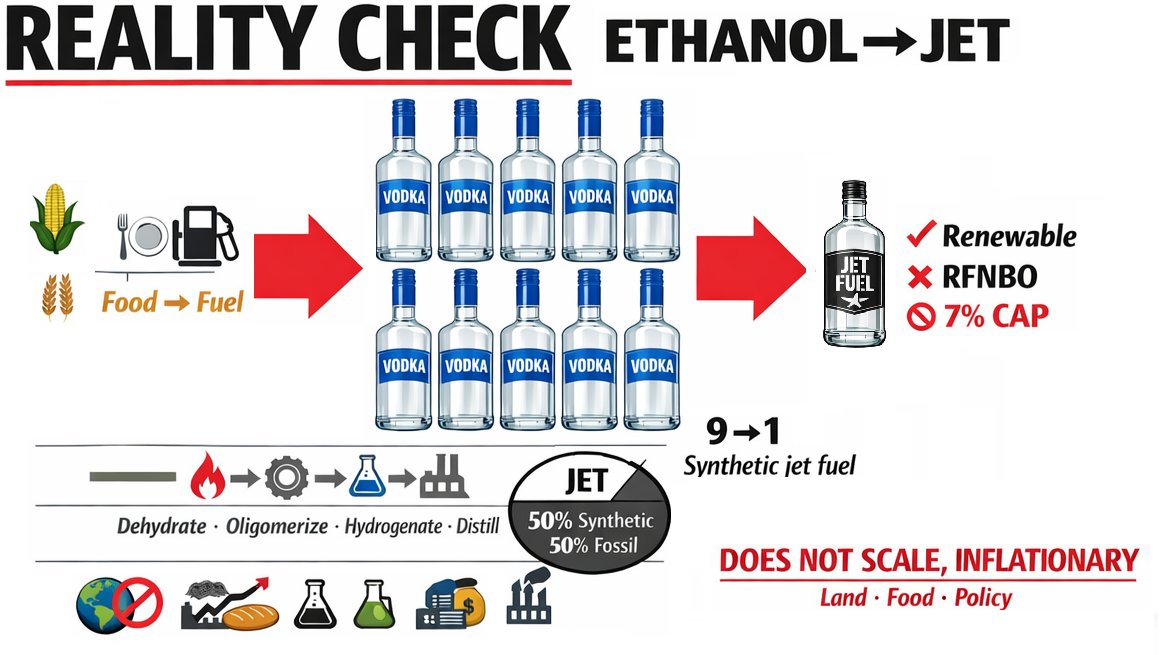
Ethanol-to-Jet (EtJ) is often presented as a pragmatic shortcut to sustainable aviation fuel, leveraging existing bioethanol production and well-understood petrochemical upgrading steps. In reality, EtJ is a chemically complex, policy-constrained, and scale-limited pathway.
Ethanol used for EtJ is predominantly produced from food and feed crops such as corn and wheat through fermentation and distillation. While this ethanol is recognised as a renewable fuel under the EU Renewable Energy Directive (RED II), it is classified as a conventional, crop-based biofuel. As a result, its contribution is capped at 7% of transport energy demand, explicitly to limit indirect land-use change (ILUC) and food market disruption. At scale, diverting agricultural output to fuel production places inflationary pressure on staple food prices, an effect already observed during earlier bioethanol expansion.
From a regulatory standpoint, EtJ does not qualify as a Renewable Fuel of Non-Biological Origin (RFNBO). The carbon backbone is biogenic, not derived from renewable electricity and captured CO₂, and the pathway therefore competes with other bio-SAF options rather than e-fuels.
Technically, EtJ mirrors Methanol-to-Jet: dehydration to light olefins, oligomerisation, hydrogenation, and extensive fractionation. Jet fuel is not a direct product but a subset of a wider hydrocarbon slate, with significant mass and energy losses across multiple processing steps. Even under idealised process assumptions, only around one-third of the original ethanol carbon ultimately appears in jet-range molecules. The remainder is distributed across light gases, non-jet liquids, and process losses, while additional hydrogen and energy inputs are required to upgrade the product slate.
This is the core EtJ reality check: the pathway converts an already energy- and land-intensive liquid fuel into a smaller quantity of synthetic kerosene
through a refinery-like chain of reactors, separators, and hydrogen loops. The appeal lies in familiarity, not efficiency. EtJ does not bypass the hard constraints facing SAF — it simply relocates them upstream into agriculture, land use, and food markets, while layering on capital intensity and regulatory caps.
In short, Ethanol-to-Jet is constrained not only by process, but by agronomy, land availability, food economics, and policy design. At a systems level, it amounts to converting large volumes of an already valuable liquid fuel into a much smaller volume of synthetic kerosene. Like Methanol-to-Jet, it performs acceptably on paper and in pilot demonstrations, but scales poorly against the volumes aviation requires. It is best viewed as a tightly bounded, transitional option rather than a cornerstone of long-term aviation decarbonisation. As with other marginal green biofuel pathways, its appeal lies less in scalability than in its ability to confer near-term green credentials while deferring the harder structural changes aviation ultimately faces.
Comments
No comments yet.