EUDR and the biochar exporter
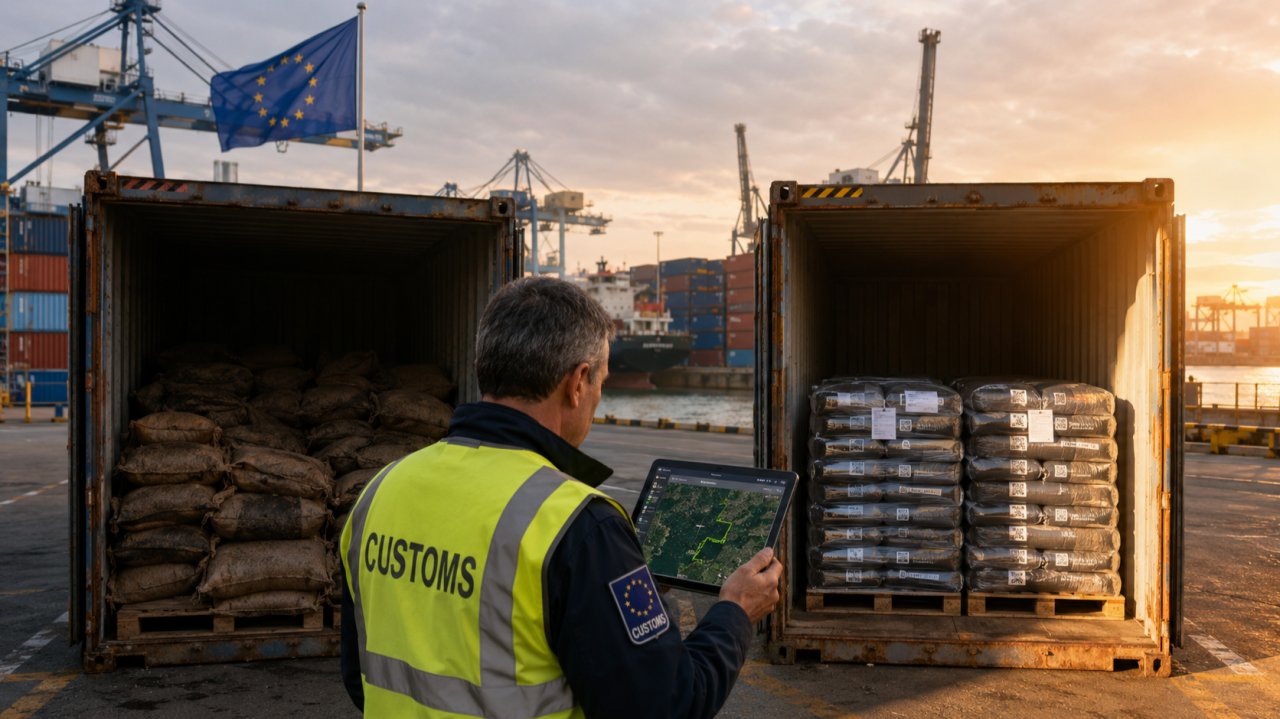
EUDR and the Biochar Exporter: Why Waste-Stream Beats Mixed Hardwood
Part 3 of a series — what the EU Deforestation Regulation actually means at the customs counter from 30 December 2026.
On 30 December 2026 the EU Deforestation Regulation (EUDR) becomes enforceable for large and medium operators; small and micro operators follow on 30 June 2027. The Commission confirmed in May 2026 that the regulation text will not be reopened. For biochar and charcoal exporters this is not a soft requirement — it changes what can clear EU customs. This article is the short version of what is in scope, what compliance looks like in practice, and why feedstock choice has just become a regulatory choice.
What Is Actually Covered EUDR is organised by Annex I product categories. Two matter directly for our segment:
• CN 4402 — Wood charcoal, whether or not agglomerated. Includes lump charcoal, briquettes, and wood-derived biochar.
• CN 4401 — Wood waste and scrap, including pellets and briquettes.
Shell and nut charcoal — coconut shell, palm kernel shell, nut shells — is explicitly included under CN 4402. The customs code does not change because the product is sold as a soil amendment or as a carbon-removal credit. If the carbon comes from wood or from a covered shell or nut, EUDR applies.
The Four Requirements
For every consignment placed on the EU market, the importer must demonstrate:
1. Deforestation-free origin — the land was forest on 31 December 2020 and has not been converted since.
2. No prohibited forest degradation — specific to wood products.
3. Legality — harvest complied with the country of production's laws on permits, tenure, labour, tax.
4. Due diligence statement — filed via the EU Information System (TRACES NT), with geolocation polygons for every harvest plot ≥4 hectares.
Where Mixed Hardwood Charcoal Breaks For artisanal charcoal made from village-collected hardwood or informal forest harvesting, the compliance bottleneck is rarely whether the harvest itself was legitimate. It is whether the documentation can be built.
A typical operation gathers wood from multiple unrelated sources — different villagers, different plots, different days. Mapping every contribution to GPS coordinates, validating each was not on post-2020 cleared land, and tracing each through to a specific sack of charcoal is not just expensive; it is often physically impossible after the fact. The cost lands on the downstream importer: consignment delayed or rejected. Having a container held up at port waiting for documentation rapidly accrues port fees.
The Waste-Stream Advantage Commercial biochar from a documented waste stream sits in a fundamentally different position. It is not exempt — biochar from wood still falls under CN 4402 — but the compliance file is buildable.
A producer using sawmill residues, plantation processing waste, oil-palm empty fruit bunch, coconut shell, durian husk, rice husk, or any clearly- sourced industrial biomass can document the single site generating the residue, the legal framework of the upstream operation (the sawmill or processing plant is licensed), and a batch-level mass balance from waste receipt through pyrolysis to product. The compliance work shifts from forensic plot-mapping to ordinary supply-chain documentation — the kind any commercial processor already has.
What This Means Commercially Two things follow:
• Tropical mixed-hardwood charcoal will become progressively harder to land in the EU, regardless of price.
• Documented waste-stream biochar and charcoal will trade at a premium — not because the chemistry is better, but because the compliance file exists.
For anyone building a biochar export business with an EU buyer base, feedstock choice is now a regulatory choice, not just an economic one. The waste-stream pivot, which the previous article in this series already made on bio-refinery economics, is reinforced by the EUDR documentation reality.
For reference, on a bulk basis charcoal and biochar briquette has a value of ~€700 / tonne ex VAT.
Next Steps To discuss how this affects a specific feedstock or supply chain, get in touch:
Comments
No comments yet.