Fertiliser price projections into 2027
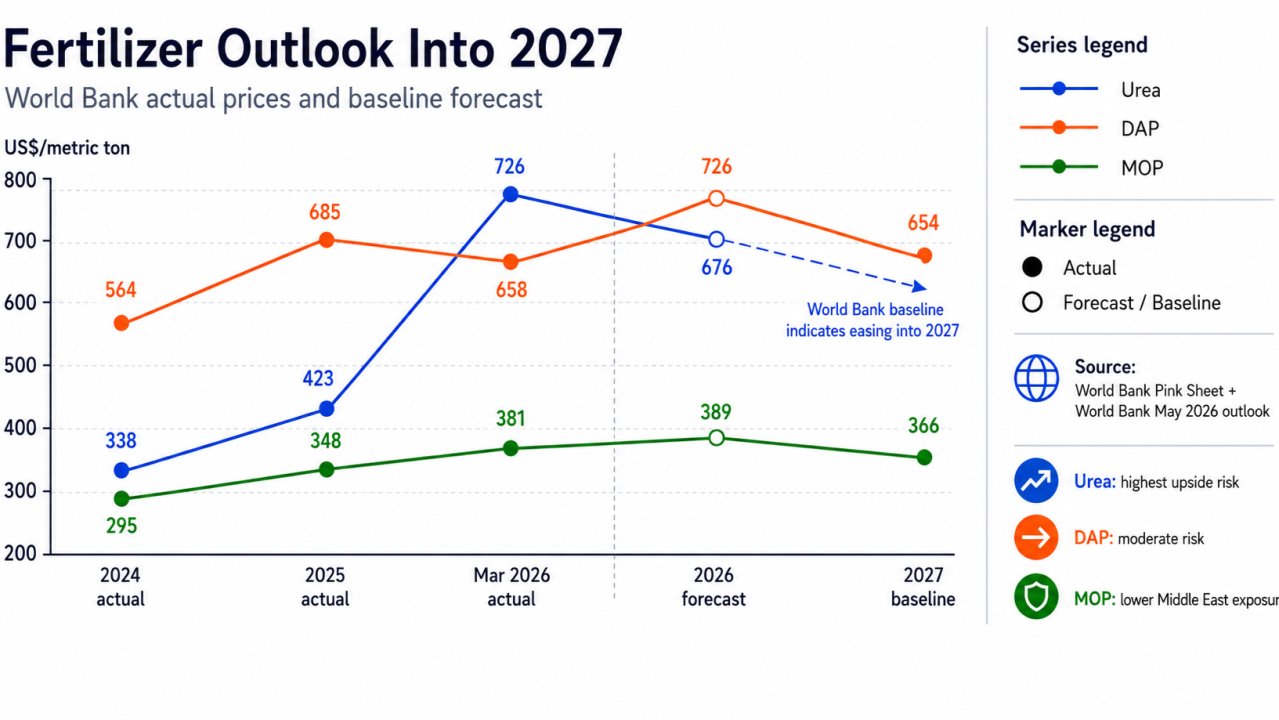
Fertilizer prices in 2027 should not be treated as a simple return-to-normal forecast.
The current outlook depends on three variables:
1. Middle East export recovery.
2. China’s fertilizer export policy. 3. Freight, insurance and fuel costs.
The World Bank’s baseline forecast is that fertilizer prices rise sharply in 2026, then ease in 2027. But that is only the baseline case. It assumes some recovery in exports, some new supply coming online, and no prolonged disruption to major shipping routes.
That assumption may or may not hold.
For urea, the World Bank projects prices to rise nearly 60% in 2026 before easing in 2027. The logic is that Middle East exports recover and natural gas prices moderate. However, this remains highly sensitive to shipping conditions. If Gulf exports remain disrupted, if war-risk insurance remains expensive, or if freight costs stay elevated, urea prices could remain above the baseline forecast.
Recent tender activity shows the scale of the risk. Reuters reported that Indian urea offers reached around US$1,000 per tonne in April 2026, almost double earlier tender levels. India is one of the largest urea importers, so these tenders are not marginal. They are a useful signal of how tight the market became when Middle East supply was disrupted.
China is also critical, whom has has restricted many fertilizer exports to protect its domestic market. Reuters reported March restrictions on nitrogen-potassium blends and certain phosphate fertilizers. Later, China allowed some fresh urea export quotas, but that should not be confused with a full reopening of fertilizer exports.
This matters for 2027 because China is one of the few suppliers large enough to affect global availability. If China releases urea, it can soften the nitrogen market. If it keeps phosphate exports restricted, DAP and MAP markets remain exposed.
For DAP, the World Bank projects a smaller increase in 2026, around 6%, followed by a decline of about 10% in 2027 as new production capacity comes online. That is a plausible base case, but phosphate fertilizer prices remain exposed to sulfur, ammonia and Chinese export policy. A restriction on Chinese DAP/MAP exports reduces the fallback supply available to importers.
For MOP, the outlook is different. Potash is less directly exposed to the Middle East. Supply is more dependent on Canada, Russia, Belarus and Laos. The World Bank projects MOP prices to rise in 2026, then ease modestly in 2027. The risk profile for MOP is therefore lower than for urea or DAP.
The main conclusion is that 2027 fertilizer prices should be assessed by scenario, not by a single forecast.
A lower-price 2027 scenario requires:
Middle East urea and ammonia exports to recover.
Freight and insurance premiums to fall. China to allow meaningful fertilizer exports. New phosphate capacity to enter the market.
Energy prices to moderate.
A higher-price 2027 scenario occurs if:
Gulf exports remain unreliable. Red Sea or Strait of Hormuz risk continues. China keeps phosphate exports restricted.
Sulfur, ammonia or gas prices remain high. Importers continue stockpiling.
In that higher-price case, fertilizer prices may fall from panic levels but still remain above pre-crisis benchmarks.
That is the key distinction.
The market may ease from 2026 peaks, but that does not mean it normalises.
For import-dependent countries, the relevant price is not the FOB price at the export port. It is the delivered price after freight, insurance, fuel, port handling, currency movement and inland transport.
This is why 2027 fertilizer affordability remains uncertain.
Prices may ease under the baseline case, but the downside is limited if shipping costs remain high and China continues to restrict exports. Urea carries the highest upside risk, DAP carries moderate upside risk, and MOP is comparatively less exposed.
For farmers and importers, the 2027 planning assumption should be continued price risk, not a guaranteed return to 2024 pricing.
Comments
No comments yet.