The green methanol paradox
A White Paper on Structural Market Failure in the Shipping Industry's Energy Transition
Executive Summary
The December 2025 collapse of Vast Renewables Limited—an Australian concentrated solar power company developing green methanol production—serves as a critical case study in the systemic failure of maritime decarbonization. Despite AU$355 million in conditional government support, innovative technology, and clear regulatory drivers from EU maritime emissions regulations, the venture entered administration unable to secure the private investment necessary to reach commercial operation.
This white paper argues that Vast Solar's failure reveals a fundamental market coordination problem: while shipping companies publicly champion their investments in dual-fuel vessels and environmental credentials, the industry systematically refuses to provide the offtake commitments, letters of intent, or infrastructure investment necessary to create the green fuel supply chain these vessels require.
Key Findings:
The shipping industry has ordered dual-fuel vessels for regulatory optionality, not environmental commitment—most continue burning conventional bunker fuel despite capability
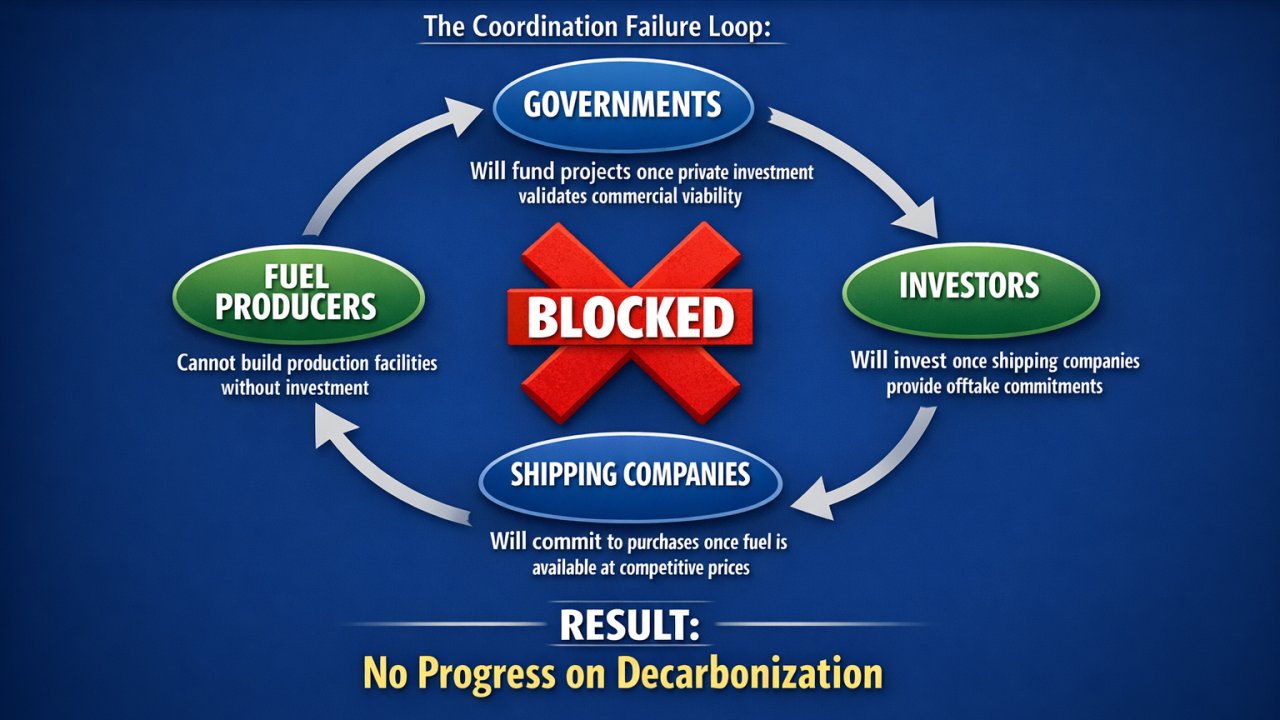
A "offtake comittment deadlock" prevents green methanol projects from securing investment: investors need offtake agreements, buyers
won't commit without proven supply, producers can't build without investment China is the only significant methanol production investor, driven by energy security strategy rather than climate goals; Europe's H2Global methanol auction failed to attract viable bids despite €900M+ in government backing
The IMO's 2023 GHG Strategy establishes long-term decarbonization targets but lacks binding enforcement mechanisms, permitting industry to signal commitment while deferring substantive action Government grant funding alone cannot catalyze projects when market structure fundamentally opposes the transition Current market and regulatory incentives suggest near-term compliance will likely be achieved through low-cost grey blended methanol rather than genuinely renewable fuels
Implications:
Without regulatory enforcement that creates unavoidable costs exceeding transition investment, or government mechanisms that directly underwrite offtake risk, maritime decarbonization will remain performative rather than substantive. The Vast Renewables case demonstrates that even AU$355 million in conditional government support cannot overcome systematic industry resistance.
Contact the author for a copy of the white paper.
Comments
No comments yet.