Indonesia's unsustainable aviation fuel mandate
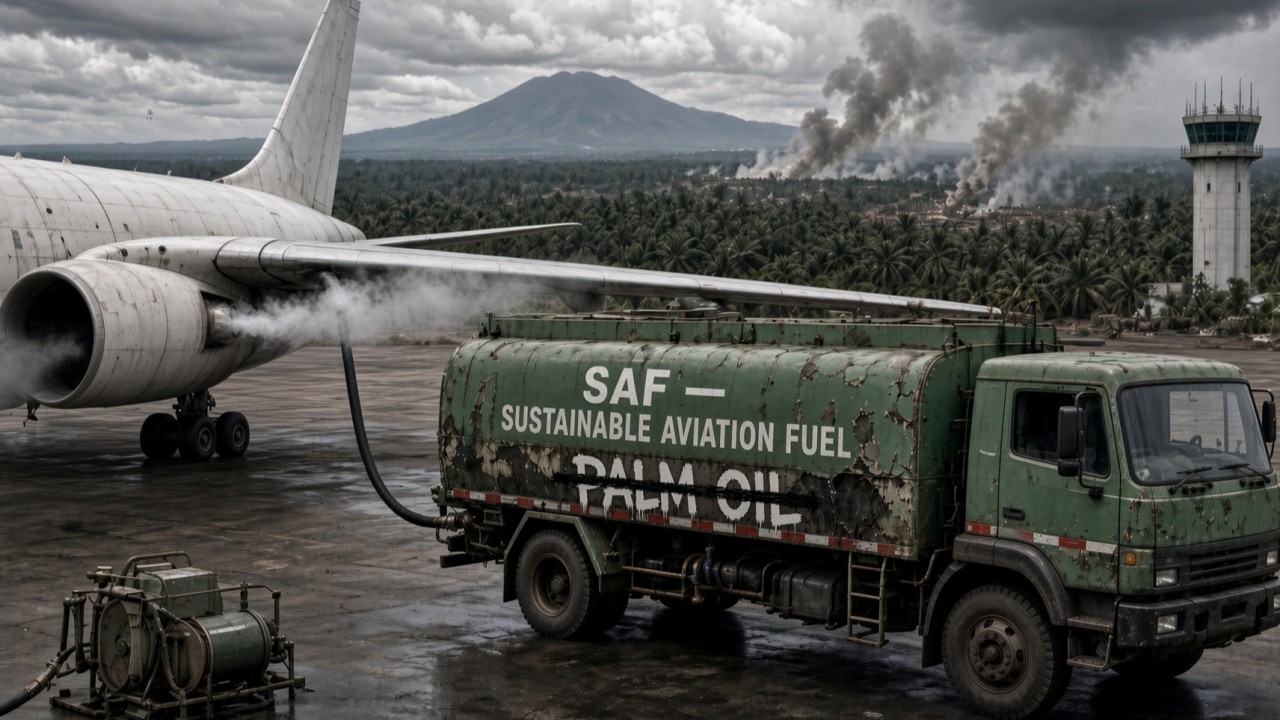
Indonesia is about to compel its airlines to buy "sustainable" aviation fuel that may not be sustainable. If the climate case is that weak, the honest question is not whether the mandate reduces emissions, It is what the mandate is really for.
From 2027, international flights leaving Jakarta and Bali are due to carry a mandatory blend of sustainable aviation fuel. The promotional language is familiar: a new market, first-mover advantage, a supply chain for investors to build. Pertamina is producing fuel, Boeing has signed a memorandum, and the government talks about an SAF "ecosystem."
There is a problem underneath the announcement, and it is worth stating plainly before asking the more interesting question. On the numbers that actually govern aviation carbon accounting, the palm-derived fuel Indonesia is most likely to lean on would deliver no climate benefit at all — and, in is worse than the fossil jet fuel it replaces.
Call it what it is: unsustainable aviation fuel — fuel counted as "sustainable" by a domestic mandate even though the relevant quantity has not demonstrated a lifecycle saving, and on the likely pathway may be worse than the fossil jet it replaces. The characterization is mine, not an official category. The point of naming it plainly is to force the question the brochures avoid: if the fuel may not cut emissions, what is the mandate for?
Follow the molecule, not the press release Palm oil can be turned into jet fuel — that part is real. ICAO lists palm as a main-product SAF feedstock, and the HEFA conversion route is approved.
But technical convertibility, a favourable model calculation, and a certified, internationally usable fuel are three different things.
Under ICAO's own November 2025 default values, the pathway most conventional Indonesian or Malaysian palm would actually take — the lower-capture default — lands at 96.6 gCO₂e/MJ. That is about 8.5% worse than the 89 fossil-jet baseline. The realistic default is a fuel dirtier than the one it replaces.
CORSIA — the international scheme that decides whether an airline may claim an emissions reduction — would reject the 96.6 pathway outright, because it fails the 10% minimum saving. The danger is not that CORSIA is lax. It is that Indonesia's domestic rules may use a different gate. The current biofuel regulation defines "bioavtur" and requires Indonesian quality and sustainability compliance, but the instruments reviewed do not expressly make CORSIA certification a condition of national mandate credit. The implementing rules could still fix that. Until they do, Indonesia has left open a route to count, as "sustainable," a fuel that international accounting would not.
So the fuel can be safe to burn but impossible to claim.
The point is not the climate. It is the import bill. Strip away the sustainability language and a much more coherent rationale appears — one the government has, in fact, stated out loud in the context of biodiesel: biofuel, "especially from palm oil," as a substitute for imported fuel.
The numbers explain the urgency. Indonesia has been a net oil importer since 2003. Domestic crude output is running near 576,000 barrels a day against consumption of roughly 1.4 to 1.7 million barrels a day — a gap that must be filled with imports. The country spent about US$32.8 billion on oil and gas imports in 2025, and the deficit continues to widen. Energy subsidies for 2026 were budgeted at around 203 trillion rupiah and may run materially higher. Every barrel of imported fuel is a claim on foreign exchange and on the state budget at the same time.
Seen through that lens, the logic is not aviation decarbonisation. It is import substitution, foreign-exchange retention, a guaranteed new outlet for palm oil, and throughput for the state-controlled fuel channel. B40 became B50 on the roads on 1 July 2026 for exactly these reasons. A SAF mandate simply extends the same instinct from the road to the wing. The molecule changes; the industrial-policy purpose does not.
These may be entirely legitimate objectives. Energy security is a real problem for a large importing archipelago, and forex retention is a rational goal. But they are not the same thing as reducing the carbon intensity of flight, and a mandate designed around what the state can label and produce is a different animal from one designed around what actually reduces emissions.
Who actually captures the mandate The first beneficiary is the palm balance sheet. Indonesia already routes palm through a low-priced domestic cooking-oil obligation, a state- allocated biodiesel programme, and export quotas. A SAF mandate adds another compulsory outlet — one more valve in a state-managed palm system that lets the government decide where the product goes and on what administratively acceptable terms.
The second beneficiary is the channel. Under the rules now in force, commercial blending of bioavtur with fossil avtur, and the sale of the
finished blend, belong to licensed petroleum-fuel businesses. At Indonesia's airports, Pertamina has been reported by the competition regulator, in a preliminary investigation, to hold 99.97% of the avtur market. So Pertamina can produce the SAF, is the practical buyer of any independent producer's neat SAF, performs the blending, dominates airport storage and into-plane delivery, and sells the finished mandate- compliant product to airlines.
Given that Indonesia's top palm oil producer, PalmCo, is also a State Owned Enterprise, the entire production pathway from field to wing is entirely vertically integrated. This is state capture in its most complete form.
None of this is unique to aviation; it fits a documented pattern. As Norman Joshua argued in July 2026, Indonesia is increasingly positioning state institutions as the compulsory intermediaries for strategic commerce — in commodity exports, in export earnings channelled through state banks, in a planned reference-price exchange. SAF is the aviation case study of the same architecture.
Why bother with the climate costume? If the real purposes are energy security, forex, a palm outlet, and SOE throughput, why dress them as sustainable aviation fuel at all?
Because the costume does work that plain import substitution cannot. "SAF" attracts investors, memoranda, and multilateral goodwill. It lets Indonesia position itself inside the ICAO/CORSIA conversation. Above all, the sustainability framing is what justifies compelling airlines to buy the product. You cannot mandate that a foreign airline buy palm oil jet fuel; you can mandate that it buy "sustainable aviation fuel."
But the costume has a cost, and it is the same cost that already grounds this fuel at the border. This fuel is likely to remain domestic-only, exactly as B50 is. B50 can be mandated on Indonesian roads but cannot be sold into the EU, because Europe will not count crop-based palm biodiesel. It hits the same wall in the air: its carbon attribute is not recognised under CORSIA or the EU and UK aviation mandates, so an airline forced to buy it on departure from Jakarta must still buy compliant fuel or offsets somewhere else. Indonesia would have created a physical obligation without a fungible climate asset — duplicate compliance cost, no international SAF.
The honest version Indonesia has a real energy-security problem, a real forex problem, and a real palm-surplus problem. It could address them openly: an import- substitution fuel programme, honestly labelled, with a binding sustainability floor so that any volume counted as "SAF" must actually beat fossil jet on a certified lifecycle basis; open, non-discriminatory access to airport blending infrastructure; recognition of book-and-claim; and an export route when domestic buyers won't contract on bankable terms.
The SAF mandate, even so, is meaningful progress — most governments still offer far less.
Sources • IEEFA — "Golden age" or energy dependence? The Indonesia–US trade deal
• Indonesia's 2026 oil situation: deepening import dependence (GK/Gan Kapital)
• Databoks — Indonesia's oil & gas imports reached US$32bn in 2025
• Reuters — Indonesia's 50% biodiesel blending takes effect, 1 July 2026
• ICAO CORSIA Eligible Fuels — conversion processes and fuel-claim requirements
• ICAO default lifecycle-emissions values, November 2025
• ESDM Regulation No. 4 of 2025 (bioavtur definition)
• FAA International Aviation Safety Assessment results, 18 April 2025
• Norman Joshua — Indonesia's economic centralisation under Prabowo (July 2026)
Comments
No comments yet.