Why green methanol-to-jet is an economic fantasy
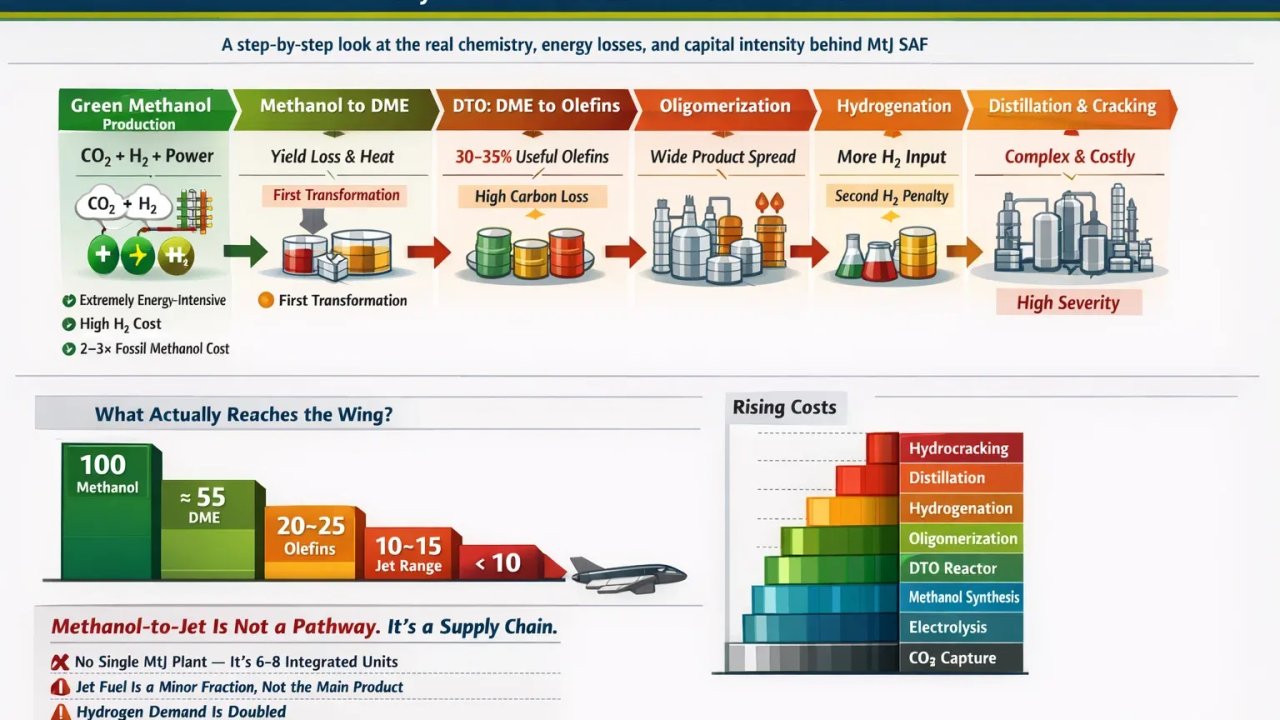
The infographic everyone promoting Methanol-to-Jet (MtJ) as sustainable aviation fuel hopes you won't see
The Promise vs. The Reality What advocates claim:
"We can convert green methanol directly into sustainable aviation fuel!"
"Methanol is a flexible platform chemical for the energy transition" "MtJ provides a scalable pathway to decarbonize aviation"
What the chemistry actually requires:
6-8 separate industrial processes, each with capital costs and energy losses
Double hydrogen penalty (once for methanol, again for hydrogenation)
Only 10-15% of input methanol carbon ends up as jet fuel
CAPEX comparable to building a full petroleum refinery
The Process Nobody Talks About: Step-by-Step Losses Starting point: 100 units of green methanol
1. Green Methanol Production CO₂ capture + green hydrogen from electrolysis Already 2-3× cost of fossil methanol Extremely energy- intensive before you even start
2. Methanol → DME (Dimethyl Ether) Catalytic dehydration First yield loss from heat rejection Remaining: ~55 units
3. DME → Olefins Only 30-35% carbon becomes useful C₂-C₃ olefins Rest becomes methane, CO, coke, waste heat High temperature, rapid catalyst deactivation Remaining: ~20-25 units
4. Olefin Oligomerization Creates broad C₄-C₂₀+ distribution Jet fuel is NOT a direct product Requires extensive separation Jet-range molecules: ~10-15 units 5. Hydrogenation Second hydrogen penalty (more electrolysis cost) More energy input stacking
6. Multi-Stage Distillation Separate light ends, kerosene, diesel, wax High energy duty Much material outside jet range
7. Hydrocracking (often required) Most capital-intensive step High- pressure hydrogen Severe operating conditions Final on-spec jet fuel: <10 units
Mass balance summary: 100 units methanol → <10 units jet fuel
The Economic Reality: CAPEX Stacks at Every Step Capital costs accumulate:
CO₂ capture facility Electrolysis plant Methanol synthesis reactor
DTO (DME-to-Olefins) unit Oligomerization reactor Hydrogenation unit
Multiple distillation columns Hydrocracking unit
Each step adds:
❌ More capital expenditure ❌ More operating costs ❌ More energy losses ❌ More maintenance complexity
Result: Total CAPEX rivals building a complete petroleum refinery, but with:
10× worse carbon efficiency 3-5× higher energy input per unit output
Tiny jet fuel yield as fraction of input
Why MtJ Doesn't Work: The Inconvenient Math Hydrogen penalty doubles:
First penalty: Making methanol from H₂ + CO₂
Second penalty: Hydrogenating olefins to jet-range paraffins
Green hydrogen cost: $4-8/kg
Process needs it twice
Jet fuel is a byproduct, not the product:
Most MtJ output is NOT jet fuel Light ends, diesel-range, wax all produced
Must find markets for co-products or economics collapse "Sustainable aviation fuel" plant makes mostly non-aviation fuel
Carbon efficiency is terrible:
90% of input carbon lost or diverted Compare to petroleum refining: 85-90% carbon efficiency
"Green" process wastes most of the captured CO₂
CAPEX per unit jet fuel is astronomical:
$500M+ facility produces maybe 50,000 tonnes/year jet fuel $10,000+ CAPEX per tonne annual capacity Compare to conventional refinery: $500-1,000/tonne capacity
The Industry Secret: MtJ Is Not a Pathway, It's a Supply Chain What "Methanol-to-Jet" actually means:
❌ Not: A single plant that converts methanol to jet fuel
✅ Actually: An integrated chemical complex with 6-8 major process units, each requiring:
Separate capital investment Specialized engineering Independent operations teams Continuous maintenance Energy inputs
The Economic Reality: MtJ vs. Conventional Refining MtJ requires 6-8 major process units vs. 3-5 for petroleum refining, achieves only 10-15% carbon efficiency vs. 85-90% conventional, consumes 3-5× more energy, requires $10,000+ CAPEX per tonne annual capacity vs. $500-1,000 for refineries, and produces co-products with uncertain markets vs. well-established petroleum product demand.
Why This Matters: The Aviation Decarbonization Distraction Airlines and fuel companies promote MtJ because:
Sounds simple: "Methanol → Jet Fuel" Appears to leverage "green energy" messaging
Allows claiming commitment to SAF without actual deployment
Kicks real solutions down the road
What they don't mention:
No commercial-scale MtJ facilities exist Pilot projects demonstrate technical feasibility, not economic viability Cost per gallon would be $15-25+ (vs. $3-4 conventional jet fuel)
Airlines won't pay even 10% premium, let alone 400-700%
The parallel to maritime methanol:
Shipping ordered dual-fuel vessels, operates on conventional fuel Aviation promotes MtJ research, burns petroleum-based jet fuel
Both industries signal transition commitment while avoiding costs Greenwashing with extra steps (literally, 6-8 extra process steps)
The Fundamental Problem: Thermodynamics Don't Care About Marketing You cannot chemistry your way around:
Energy losses in each conversion step Hydrogen's high production cost Low carbon yield through DTO process Need for expensive separation equipment Stacking capital costs
MtJ works on paper. Aviation runs on economics.
The inconvenient truth:
If green methanol were cheap enough to make MtJ viable, you'd burn the methanol directly (it's already a fuel) If hydrogen were cheap enough to justify double penalty, you'd use it directly in fuel cells If CO₂ capture were cheap enough to waste 90%, the climate problem would be easier
MtJ requires all three to be cheap simultaneously. None are.
What This Reveals: The Pattern Across "Green Fuel" Failures Three recent collapses, one common thread:
1. Vast Renewables (green methanol, AU$355M government support) Couldn't secure investment despite massive subsidies Shipping industry wouldn't commit to purchases Liquidated December 2025 2. Energy Renaissance (battery manufacturing) Couldn't compete with Chinese state-backed imports No local content requirements in government projects Liquidated August 2025 3. MtJ sustainable aviation fuel (ongoing fantasy) Economics don't work at any reasonable fuel price No commercial deployment despite years of research Airlines promoting the concept.
Common pattern:
✅ Technology technically feasible ✅ Government research funding ✅ Industry public support ❌ Economic viability ❌ Market deployment ❌ Industry willingness to pay premium
Conclusion: Stop Pretending Complexity Is a Feature The MtJ pitch: "Green methanol is a versatile platform chemical that can be converted to sustainable aviation fuel through established chemical processes."
The reality: "We stack 6-8 energy-intensive, capital-intensive processes, lose 90% of the carbon, use hydrogen twice, and produce a fuel that costs 5-7× conventional jet fuel, most of which isn't even jet fuel."
When someone promotes Methanol-to-Jet, ask them:
What's the mass balance? (They won't have one)
What's the CAPEX per tonne jet fuel? (lets do a feasibility study on that) What's the hydrogen cost assumption? (It'll be some broad range)
Who's paying the 400-700% fuel premium? (Nobody)
MtJ is where green methanol hype goes to die.
Just like Vast Renewables' green methanol for shipping.
Just like Energy Renaissance's domestic battery manufacturing.
Complexity compounds costs. Thermodynamics always wins. Economics eventually matter.
Until aviation and policymakers accept that sustainable aviation fuel requires either:
Direct investment in proven pathways (HEFA from waste oils, power- to-liquids) Carbon taxes that go to real infrastructure investments instead of coffers Mandatory blending requirements with enforcement Acceptance of dramatically higher ticket prices
...expect more greenwahing hype, more MtJ research announcements, more pilot projects, and zero commercial deployment.
The infographic tells the story the press releases won't.
Comments
No comments yet.