Biomass potential of an intensive energy-crop farm in the Northern Territory
Introduction
The Douglas Daly region of the Northern Territory is an established agricultural district in northern Australia, characterised by deep, well- drained soils responsive to fertiliser inputs, high solar radiation, and a strongly seasonal tropical climate. These characteristics make the region very well suited to high-biomass energy-crop systems, particularly where irrigation is used strategically to complement wet-season rainfall.
This article examines the biophysical production capacity of a hypothetical 2,000-hectare energy-crop farm in the Douglas Daly region. The assessment is intentionally limited to what the land and water can physically produce, measured as annual dry matter (DM) biomass, and does not consider prices, logistics, processing pathways, or commercial viability.
The farm configuration analysed consists of:
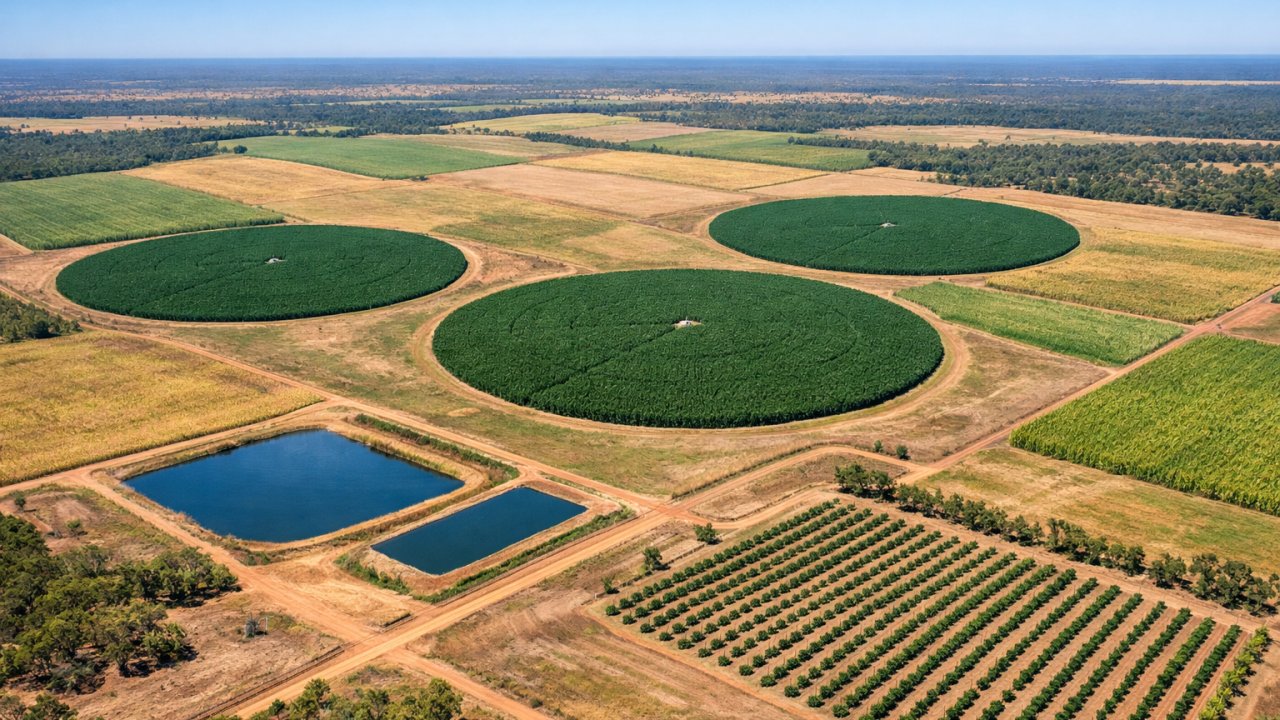
180 hectares under centre-pivot irrigation, planted exclusively with Napier (elephant) grass
850 hectares of dryland cropping, planted with forage sorghum or sorghum–sudan hybrids
200 hectares of drip irrigated jatropha. 3,000 ML per annum of licensed water, with some surplus water allocated to drip-irrigated perennial energy crops, such as jatropha
The production strategy is explicitly oriented toward typical intensive to high-biomass systems, rather than low-input pasture or grazing models.
Climate and biomass fundamentals
Douglas Daly experiences a tropical savanna climate, with a distinct wet season from approximately November to March and a long dry season from April to October. Average annual rainfall is approximately 1,200–1,300 mm, with around 80–85% falling during the wet season.
Temperatures remain favourable for biomass production year-round:
Mean daily maximums typically range from 31–38°C Mean minimums rarely fall below the mid-teens °C
Frost risk is effectively zero
From a biomass perspective, this climate offers:
High radiation interception Rapid vegetative growth
Long growing seasons Strong responsiveness to water and nitrogen
The key production constraint is not heat or sunlight, but water availability outside the wet season and nutrient replacement under very high biomass removal rates.
Irrigated biomass system: Napier grass under centre pivots
Napier grass (also known as elephant grass) is one of the highest-yielding biomass crops available in tropical and subtropical environments. When managed for biomass rather than forage quality, it exhibits:
Extremely high growth rates
Strong response to irrigation and fertiliser Excellent regrowth following cutting High annual dry-matter accumulation
Napier is widely recognised as a benchmark crop for maximum biomass output in warm, high-radiation environments.
Irrigation intensity and water use
The farm holds 3,000 ML per annum of water entitlement across 180 hectares of pivot-irrigated land, equating to a theoretical maximum of ~16.7 ML/ha/year if fully applied.
In practice, typical intensive Napier systems do not require or benefit from such extreme application rates. Field experience in tropical systems indicates that:
8 to 12 ML/ha/year of applied irrigation is sufficient for sustained high yields Additional crop water demand is met through stored soil moisture and early wet-season rainfall
Water use efficiency declines beyond this range due to drainage losses and physiological limits
For this analysis, Napier grass is assumed to be managed under typical intensive to high-biomass irrigation, with:
9 to 12 ML/ha/year applied irrigation
Multi-cut harvest regime Full nutrient replacement
This implies total pivot water use of 1,600 to 2,200 ML per annum, leaving meaningful surplus water available for other uses.
Napier grass biomass yields
Under irrigated tropical conditions, Napier grass dry-matter yields vary depending on cutting frequency, fertiliser inputs, and stand age.
Typical intensive systems:
5 to 7 cuts per year
Individual cut yields of 5 to 7 t DM/ha Annual yields of 30 to 40 t DM/ha
High-biomass systems:
Frequent cutting with aggressive fertilisation Strong dry-season irrigation
Annual yields of 45 to 60 t DM/ha
For planning purposes, the following ranges are appropriate:
Management intensity
Under normal intensive operation, the pivot-irrigated Napier system can be expected to produce 6,000 to 8,000 tonnes of dry biomass per year, with upside potential approaching 10,000 tonnes DM.
Role of Napier in the whole-farm system
Napier grass provides:
Highly predictable biomass output Dry-season production capability A stable baseline against which variable dryland production can be balanced
From a purely physical production standpoint, the irrigated Napier area is the most reliable and controllable biomass source on the farm.
Dryland biomass system: forage sorghum and sorghum–sudan hybrids
Suitability of sorghum systems
Forage sorghum and sorghum–sudan hybrids are the dominant high- biomass dryland crops in northern Australia. They are particularly well suited to the Douglas Daly environment due to:
Strong tolerance of episodic heavy rainfall
Rapid early growth during the wet season High conversion efficiency of water into biomass Flexibility in harvest timing
These crops are typically grown as single wet-season biomass crops, harvested once at peak biomass.
Wet-season growth dynamics
Dryland biomass production is driven almost entirely by wet-season rainfall. In Douglas Daly:
Wet-season rainfall is sufficient to fully meet crop water demand High temperatures accelerate canopy closure
Biomass accumulation is rapid over a 3–4 month window
Once the wet season ends, growth effectively stops, making timing of harvest critical to maximise recoverable dry matter.
Dryland sorghum biomass yields
Under typical intensive dryland management in high-rainfall northern environments:
Forage sorghum yields of 10 to 14 t DM/ha are common Above-average seasons can exceed 15 t DM/ha Poorly timed seasons may fall below this range, but are outside the scope of this assessment
Applying a typical intensive planning range of 11 to 14 t DM/ha:
A long-run expectation of 9,350 to 11,900 tonnes DM per annum from dryland sorghum is reasonable.
Role of dryland sorghum in the system
Dryland sorghum provides:
Large-scale biomass volumes Strong alignment with monsoonal rainfall Lower infrastructure intensity than irrigated systems
While less predictable than irrigated Napier, dryland sorghum is the single largest contributor to total farm biomass.
Drip-irrigated perennial energy crops: jatropha
Rationale for a third production stream
After allocating water to the centre pivots, the farm retains surplus water capacity within the licensed entitlement. This water can be deployed more efficiently through drip irrigation to support perennial energy crops that:
Require lower annual water volumes Benefit from targeted irrigation Provide year-round biomass or seed production
Subesequent uses for the biomass would benefit from an oil rich component
Water use and scale
Perennial oilseed or biomass shrubs under drip irrigation typically require:
2 to 4 ML/ha/year, depending on spacing and climate
Significantly less water than pivot-irrigated fodder crops
Assuming 800 ML/year of surplus water is allocated to drip irrigation, this supports:
200 hectares of perennial energy crops
Biomass and seed production characteristics
Jatropha systems produce biomass as seeds which contain;
1. Oil from the seed 2. Press Cake
From a biomass perspective:
Seed yields vary widely but commonly fall in the range of 2 to 4 t/ha under irrigated tropical conditions
This equates to:
400 to 800 tonnes of seed ~250 tonnes of recoverable oil
Whole-farm biomass production summary
Under typical intensive operation, total farm biomass production of 16,000–20,000 tonnes of dry matter per year is realistic. Under favourable seasons and high-biomass management, total output can exceed 22,000 to 25,000 tonnes DM annually.
Conclusion
When configured around Napier grass under pivot irrigation, forage sorghum on dryland, and drip-irrigated perennial energy crops, an energy-crop farm in the Douglas Daly region exhibits exceptional physical biomass productivity.
Crucially, these production levels are achievable without extreme irrigation rates, relying instead on efficient water allocation, crop selection aligned to seasonal rainfall, and intensive but realistic management. From a purely biophysical standpoint, the system demonstrates that biomass availability at scale is not a limiting factor in this environment.
While the region supports established large-scale biomass production, there are currently no dedicated energy-crop farms, leaving a clear and
unrealised commercial opportunity to pivot toward a bioenergy feedstock industry in the region.
Comments
No comments yet.