Palm Acid Oil (PAO) is not a residue. It is a product.
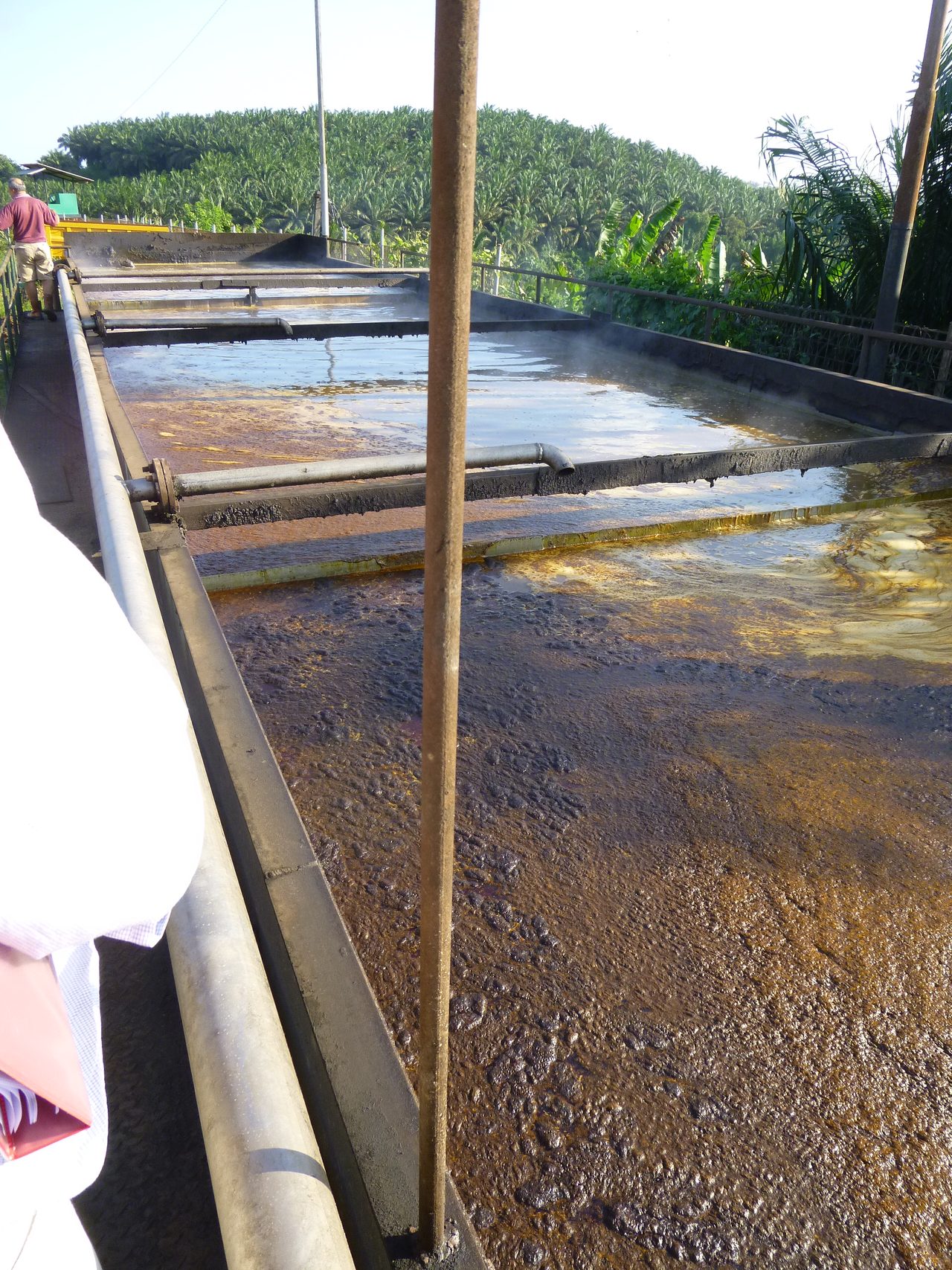
A de-oiling pit at a palm oil mill. A thick layer of crude palm oil floats on hot effluent. Under ISCC rules, this oil can be certified as waste.
Europe counts oil recovered from palm oil mill effluent as one of the cleanest feedstocks it has. POME sits in Part A of Annex IX of the Renewable Energy Directive, the advanced list, alongside straw and sewage sludge. Biodiesel made from it counts double towards transport targets in several member states. The premise is that the oil is a residue: something left over, with no better use, that would otherwise be lost.
Anyone who has stood at the edge of a cooling pond at a palm oil mill knows that premise is wrong. The oil has a use, a market and a price. It is a product.
How the oil gets there
A palm oil mill produces large volumes of hot, oily wastewater: condensate from the sterilisers, sludge from the clarification stage, and wash water. That effluent first flows into a de-oiling pit, often called the fat pit. While the effluent is still hot, the oil floats to the top. The underflow is pumped on to an open cooling pond, and when enough oil has collected in the de-oiling pit it is drawn off. That oil has barely changed since it left the press. It is crude palm oil.
Whatever oil escapes the de-oiling pit reaches the cooling pond, before the effluent goes on to treatment or to a biogas plant. There the oil separates and floats. At night, as the temperature drops, it solidifies into a fatty crust across the surface. During the day it melts back into a thick, viscous top layer. Over a few weeks, several inches of rancid oily material accumulate.
What happens to it
At some mills, what happens next is not in any mass balance.
The quantity of fat in the cooling pond is under-reported, or not reported at all. In the early hours of the morning, while the crust is still solid, it is scooped into 44 gallon drums and taken off site. The drums are left in the sun until the fat melts back into oil, which is filtered into clean drums. The result is palm acid oil (PAO). It is rancid, but it has value.
In that form it is sold locally as cheap cooking oil, undercutting branded products. Some of it is chemically bleached so it looks like refined palm oil and then washed to remove the rancidity.
At other mills the transaction is more formal. Local operators buy the contents of the cooling pond directly from the mill, on paper. That too can be a side arrangement, with the proceeds shared between the parties involved to maintain the code of silence.
None of this describes every mill. It describes enough of them that anyone who works around these plants recognises it.
What the rules say
The Renewable Energy Directive defines a residue as a substance that is not the end product a process directly seeks to produce, is not a primary aim of the process, and comes from a process that has not been deliberately modified to produce it.
ISCC, the main certification scheme, defines POME as the unavoidable wastewater from palm oil production, and POME oil as any oil recovered from that wastewater, whether it is skimmed from a pond or recovered before the effluent reaches one. It draws no line between hot oil drawn off a de-oiling pit, which is crude palm oil in all but name, and degraded fat skimmed from a cooling pond. Both can be certified as POME oil. The image at the top of this article is what that looks like: a layer of crude palm oil, inches thick, sitting on a pit of hot effluent, eligible to enter Europe as an advanced waste feedstock.
Since April 2023, ISCC has required individual certification of mills supplying POME oil, with auditors checking declared volumes against expected yields. Those yields run from 2.1 to 7.6 kg per tonne of fresh fruit bunches for mills with horizontal sterilisers, and from 6.0 to 28.8 kg for vertical sterilisers. That plausibility range is too wide to detect a truckload of oil drums leaving before dawn, in either direction.
The market has already answered
If POME oil were a residue, it would trade like one. It does not.
By mid-2024, POME oil was trading at close to 90% of the crude palm oil spot price, according to Transport & Environment. In December 2025 the Malaysian spot price was $1,048 a tonne. A residue that sells for nine tenths of the main product is not a residue.
The volumes do not add up either. T&E estimates that Europe and the UK consumed around 2 million tonnes of POME oil in 2023, against a maximum global potential of about 1 to 1.5 million tonnes. ISCC disputes that estimate and puts the potential nearer 3 million tonnes, but even its figure leaves little room for the growth in European demand.
Regulators have noticed. In October 2024 Ireland, Belgium, Germany and the Netherlands asked the Commission to investigate, noting that reported consumption exceeded estimated global production potential. Germany and the Netherlands are considering cutting POME oil from double to single counting. EU imports fell 33% in the first nine months of 2025. Indonesia has restricted POME oil exports since January 2025 to keep it for its own biodiesel mandate. In Malaysia, the Palm Oil Board has classified steriliser condensate oil, which ISCC counts as POME oil, as crude palm oil.
Why the classification matters
Calling POME oil a residue has five consequences, and all of them are wrong.
The first is displacement. The acid oil sold off the back of a truck is local villagers' cooking oil. When a European biodiesel buyer outbids that market, the people who were buying it do not stop cooking. They buy palm oil instead. The demand for palm does not disappear; it moves to the virgin product. That is the same reason PFAD is treated as a co-product rather than a waste.
The second is the incentive. When the oil in the effluent is worth close to the price of crude palm oil, a mill loses very little by letting more of it reach the de-oiling pit, and may gain a great deal if that oil earns double-counting value in Europe. The residue definition excludes processes deliberately modified to produce the residue. No audit can tell the difference between oil that was lost and oil that was allowed to be lost by cracking open the clarifier bypass valve a touch or switching off a centrifuge.
The third is the biogas plant. Fats are the most energy-dense part of the effluent: a tonne of oil can yield roughly 1,000 cubic metres of methane in a digester, about twice as much as the same mass of carbohydrate. Every tonne skimmed and sold is a tonne the biogas plant does not digest. The operator who scoops the fat is taking methane out of the project that the methane credits are paying for.
The fourth is methane released, not just methane lost, and it turns the policy on its head. Mills have worked out what acid oil is worth, and some are installing additional de-oiling pits to capture more of it. Every extra pit is another open pond where effluent sits uncovered before it reaches treatment or a biogas plant. The longer POME stands in an open pond, the more of its organic load breaks down without oxygen and escapes to the air as methane. A rule written to cut emissions from transport is adding methane to the atmosphere. None of it shows up in the biofuel's carbon accounting: under the Renewable Energy Directive, a residue carries zero emissions up to the point it is collected.
The fifth is where the oil ends up. The crude palm oil drawn off a de-oiling pit does not go to the village. It is certified as POME oil and shipped to Europe, where it becomes HVO, biodiesel and increasingly SAF. Those markets are already long: EU suppliers delivered 2.8% SAF in 2025 against a 2% mandate. Every tonne of crude palm oil that enters as a residue earns double-counting value, competes directly with genuine waste oils for the same refinery capacity, and undercuts the producers who are doing it properly.
What should change
POME oil should be treated as what it is: a product of the mill, with a local market and a price close to crude palm oil. Oil drawn off a de-oiling pit should be counted as crude palm oil, as Malaysia already does for steriliser condensate oil.
That means taking POME oil off the Annex IX Part A list, and in the meantime ending double counting, as Germany and the Netherlands are already considering. It means assigning it upstream emissions like any other co-product of crude palm oil. And for any volume that does qualify, it means measured recovery: metered flows into and out of the de-oiling pit and the cooling pond, recorded at the mill, reconciled with the biogas plant's own feedstock data, rather than a declaration checked against a yield range wide enough to drive a truck through.
The effluent itself is different. POME digested in a covered lagoon or a tank, with its oil content still emulsified, is a genuine waste stream, and biogas from it remains one of the best uses of a palm oil mill's output.
POME oil was never a by-product. The cooling pond fat has had a market for as long as there have been cooling ponds.
Maybe the villagers will get their cooking oil back.
Sources
- Transport & Environment, "Palm oil in disguise?", March 2025
- ISCC, "Understanding POME: Context and Controversy", August 2025
- ISCC Guidance, Waste and Residues from Palm Oil Mills, version 3.2 (public consultation)
- Transport & Environment, "'Renewable diesel' sold by oil majors most likely contains fraudulent palm oil"
- Klean Industries, "Why European SAF premiums are falling despite growing demand", October 2026
- Argus, "States ask EU to look into palm oil waste biofuels", 14 October 2024
- S&P Global, "Commodities 2026: Regulatory uncertainty impedes palm oil mill effluent trade", December 2025
- S&P Global, "Indonesia restricts UCO, palm oil residue exports ahead of B40 biodiesel mandate", 8 January 2025
- Directive (EU) 2018/2001 (Renewable Energy Directive), Article 2 and Annex IX
Method note: the methane yield of about 1,000 cubic metres per tonne of fat is the standard theoretical value for lipids in anaerobic digestion.
Comments
No comments yet.