Dryland energy cropping in the Roper region
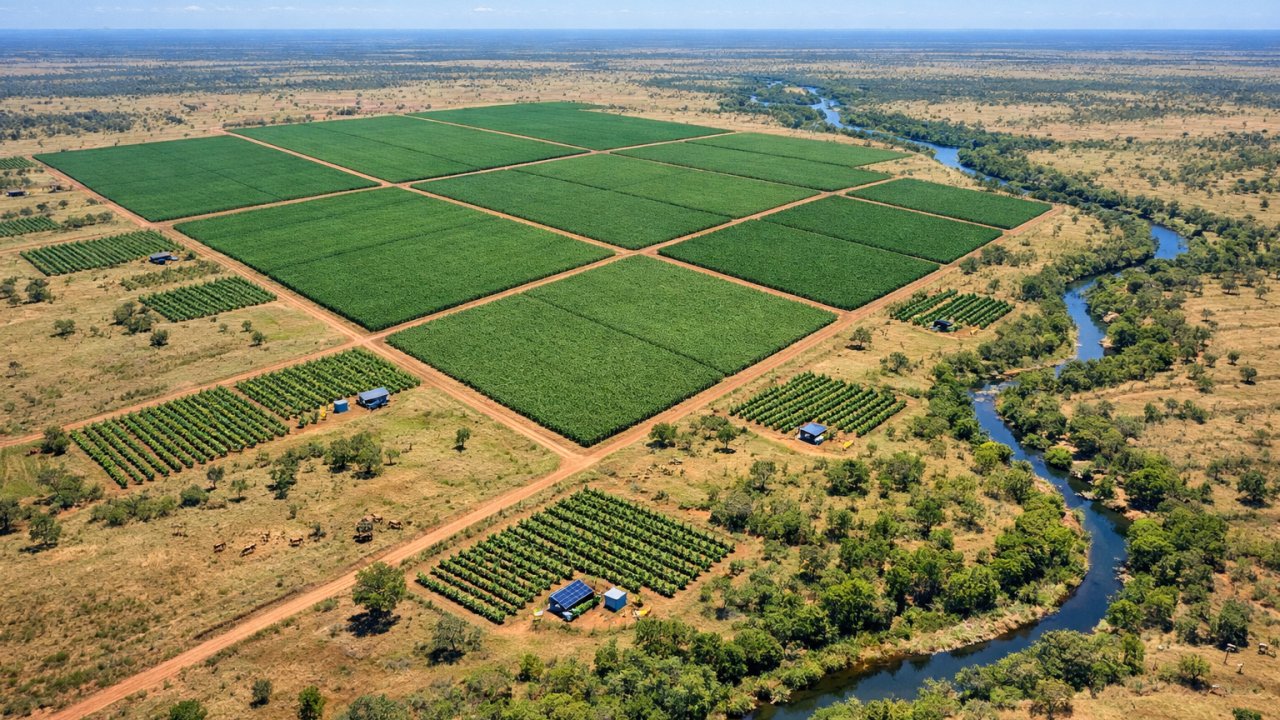
Large-scale dryland energy cropping in the Roper region: an unrealised opportunity
Northern Australia contains some of the largest contiguous landholdings capable of supporting biomass production at scale, yet dedicated energy cropping remains largely absent. The Roper region exemplifies this structural gap. Despite extensive pastoral development, reliable water resources, and favourable climatic conditions, land use remains overwhelmingly focused on cattle production rather than high-output dryland energy crops.
Existing land use and degree of development
Large pastoral properties in the Roper region typically comprise a mix of:
Native savanna woodland
Improved and semi-improved pastures Cleared paddocks developed over decades for cattle grazing
Riparian corridors and conservation buffers
These areas already support mechanised land management, vehicle access, and pasture renovation, making them the most realistic candidates for conversion to dryland cropping without extensive new clearing.
Importantly, the remainder of the property continues to operate as a cattle enterprise, preserving livestock production while enabling diversification rather than wholesale land-use change.
For the purposes of this article, it is assumed that 11,000 hectares of existing developed paddocks on a hypothetical 110,000-hectare pastoral holding are allocated to dryland energy cropping. These paddocks are already cleared, fenced, and accessible, allowing conversion to cropping without extensive new land development. Cattle production continues across the remaining ~100,000 ha land area, ensuring that energy cropping is introduced as a complementary land use rather than a replacement enterprise.
Climate suitability for dryland energy crops
The Roper region experiences a tropical savanna climate with:
A distinct wet season (approximately November to March)
A long, dry season with minimal rainfall
High annual solar radiation Consistently warm temperatures throughout the year
Average annual rainfall typically falls in the 900 to 1,200 mm range, concentrated in the wet season. These conditions are well aligned with short-cycle, high-biomass dryland crops that can complete most of their growth during the wet season and be harvested early in the dry season.
Critically, this climate supports:
Rapid canopy development High water-use efficiency during peak rainfall Predictable harvest windows once rainfall ceases
Dryland energy cropping systems at scale
The most suitable dryland energy crops for large-scale deployment in the region are forage sorghum and sorghum–sudan hybrids, selected and managed for biomass rather than forage quality.
Under typical intensive dryland management in northern Australia:
Wet-season forage sorghum yields of 10–14 tonnes of dry matter (DM) per hectare are achievable
Strong seasons can exceed this range Crop cycles align well with the monsoonal rainfall pattern
These crops are:
Mechanically harvestable
Highly responsive to nitrogen Well understood agronomically in northern environments
Applied across 11,000 hectares, this implies an annual dryland biomass output of approximately:
110,000–154,000 tonnes DM per year
This dryland system forms the dominant biomass platform of the property, driven by scale rather than irrigation intensity.
Role of water: enabling, not replacing dryland systems
While the primary production model is dryland, many pastoral properties in the Roper region have access to:
Groundwater via permanent bores Surface water from rivers and creeks Existing solar-powered pumping and reticulation infrastructure
This water is not intended to fully irrigate crops. Instead, low-volume, high-efficiency drip irrigation can be deployed strategically to:
Support crop establishment in marginal years Enable perennial or oilseed energy crops on limited areas
Stabilise biomass output without undermining the dryland model
Water therefore acts as a risk-management and diversification tool, not the backbone of production.
Coexistence with cattle production
Crucially, this model does not displace cattle production. Instead:
Grazing continues across the majority of the holding Energy crops occupy selected developed paddocks
Crop rotations can be integrated with pasture renovation Residual biomass and stubble can support grazing systems
This creates a hybrid land-use system where cattle remain the base enterprise, while energy cropping introduces a second production layer without requiring wholesale transformation.
The unrealised opportunity
Despite the physical suitability of the region, there are currently no dedicated large-scale dryland energy-cropping enterprises operating in the Roper region. Existing land use reflects historical norms rather than biophysical limits.
The absence of energy cropping does not stem from:
Lack of land Lack of water Unsuitable climate
Inadequate farm-scale infrastructure
Instead, it reflects the absence of a commercial catalyst and first-mover projects.
Supplemental energy cropping: jatropha under bore-fed drip irrigation
In addition to large-scale dryland cropping, many pastoral properties in the Roper region have access to permanent groundwater bores originally developed for livestock watering. These bores, often equipped with solar- powered pumps, provide a reliable but limited water supply that is not
suited to broad-acre irrigation, but is well matched to targeted drip- irrigated perennial energy crops.
Conceptual layout and scale
A typical bore can practically support one drip-irrigated field without excessive drawdown or pumping infrastructure. Across a large pastoral holding, it is reasonable to assume that approximately 12 bore-fed drip fields could be established in proximity to existing groundwater infrastructure.
Assuming:
15–25 hectares per drip-irrigated field 12 fields in total
This results in a jatropha planting area of approximately 180–300 hectares, spatially distributed across the property rather than concentrated in a single block.
Water use characteristics
Jatropha (Jatropha curcas) is a drought-tolerant perennial oilseed shrub, but commercially meaningful yields require supplemental water, particularly during establishment and flowering.
Under drip irrigation in a tropical savanna climate:
Typical applied water demand is 2–4 ML/ha/year
Total water use across 12 fields (180–300 ha) is therefore 360–1,200 ML/year This level of extraction is consistent with multi-bore pastoral water systems and does not approach the scale of full irrigation schemes
The role of water in this system is enabling rather than intensive, providing yield stability and allowing perennial energy cropping to coexist with dryland systems.
Jatropha production profile
Jatropha contributes energy primarily through oilseed production, not bulk biomass. Under irrigated tropical conditions, realistic long-run yields are:
Seed yield: 2.0–4.0 tonnes per hectare per year Oil content: ~30–38% by weight Recoverable oil: ~30–32% of seed mass after extraction
Applied across 300 hectares, this equates to:
Seed output 600–1,200 t seed
Recoverable oil ~190–380 t oil
This corresponds to approximately 120,000 to 420,000 litres of crude jatropha oil per year, depending on planting density and management intensity.
In addition to oil, the system produces press cake, representing roughly 65–70% of seed mass, which constitutes a secondary solid biomass stream.
Functional role within the whole system
Jatropha does not compete with dryland energy cropping on scale or tonnage. Instead, it provides:
A liquid energy output distinct from lignocellulosic biomass A perennial production stream with low annual re-establishment cost Efficient use of small but reliable groundwater resources Spatial diversification across the property
Importantly, jatropha is not managed for woody biomass. The standing plant structure is retained as productive capital, with energy output derived from seeds and oil rather than harvested wood.
Revised system summary
Under this configuration:
Dryland energy crops (11,000 ha): 110,000–154,000 t DM/year Drip-irrigated jatropha (180–300 ha): 120,000–420,000 L oil/year 250–800 t/year of press-cake biomass
This layered approach combines scale-driven dryland biomass with targeted liquid-energy production, enabled by existing bore infrastructure rather than large-scale irrigation development.
Conclusion
In the Roper region, large pastoral holdings already contain thousands of hectares of developed paddocks capable of supporting dryland energy crops. The continued dominance of grazing, in the absence of dedicated energy cropping, represents a clear and unrealised opportunity to establish a large-scale bioenergy feedstock industry without displacing existing cattle operations.
Comments
No comments yet.