EUDR, ILUC and CORSIA assessments
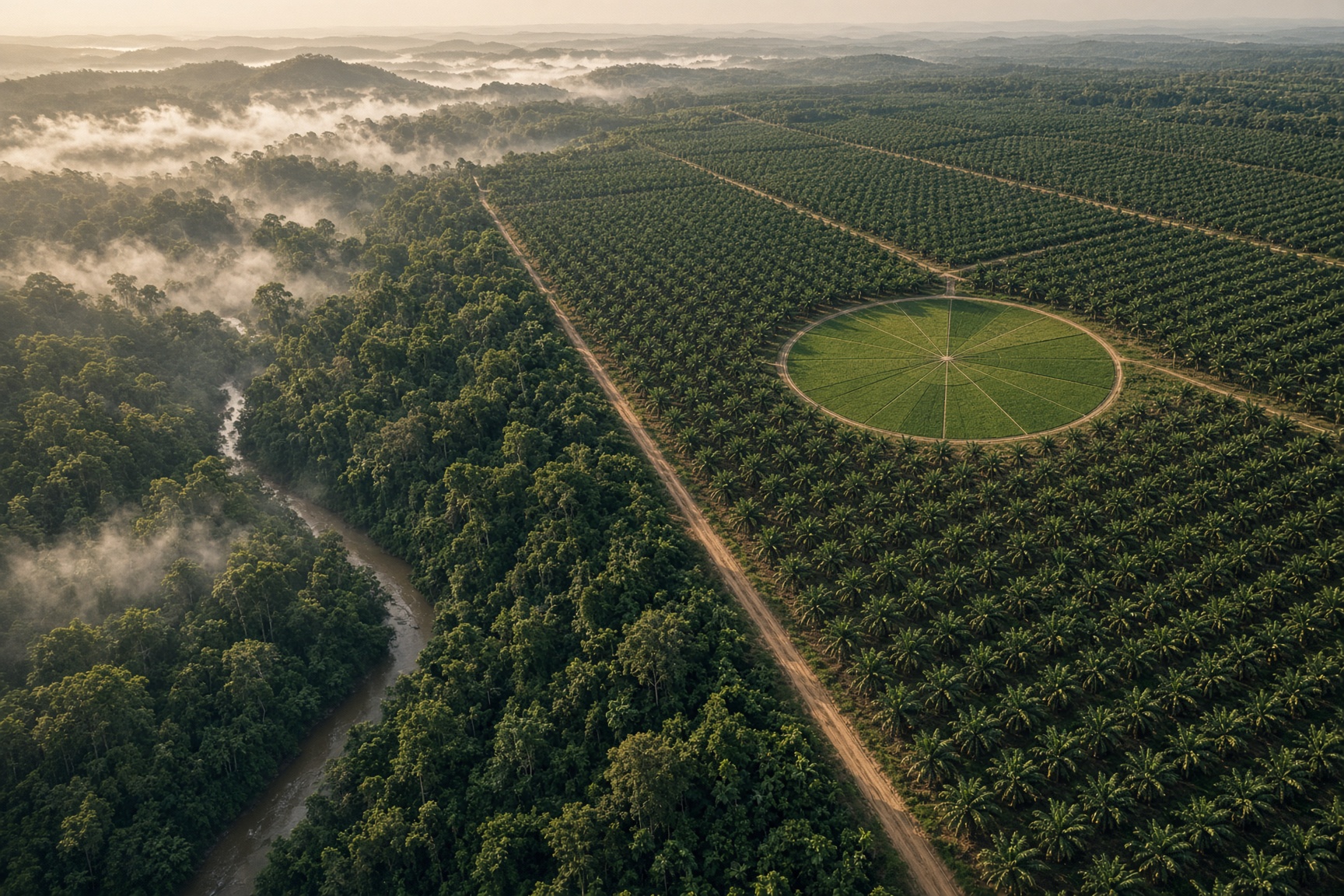
A biofuel project earns its market access on paper as much as on steel. Three regimes decide whether a fuel can be sold into the European Union, counted toward a target, or claimed by an airline: the EU Deforestation Regulation (EUDR), the land-use-change test that sits under every sustainability scheme (DLUC and ILUC), and CORSIA for aviation fuel. We prepare the assessments that answer them, on the same custody and land evidence the platform records. An assessment states a position and the evidence behind it. It does not grant a certificate; an approved scheme does that.
EUDR due diligence
An EUDR assessment establishes which products in a chain are in scope, by customs code rather than by sustainability claim, fixes the deforestation-free status against the 31 December 2020 cut-off, and sets out the plot geolocation, legality evidence and due diligence statement the operator must lodge. For a palm and biomass chain the exposure concentrates in crude palm oil, wood and wood residues, and biochar sold as wood charcoal; most finished fuels fall outside the regulation in their own right, while the feedstock behind them does not. The longer treatment of which products are caught is set out under EUDR and deforestation-free trade.
Land use change: DLUC and ILUC
A land-use-change assessment answers two questions for a certification file: was the site forest, and what are the direct and indirect land-use-change consequences. Land status is read directly from the national forest dataset, pixel by pixel and year by year, against the 1 January 2008 benchmark the schemes use. The clearing record is split at the benchmark, post-benchmark clearing is attributed to forest or to grassland conversion in the year before it was cleared, and the feedstock siting is checked so that fuel feedstock stays off land converted from forest after the cut-off. The result is a defensible direct-land-use-change position and the evidence list a scheme will ask for.
CORSIA compliance and GHG lifecycle
A CORSIA assessment establishes whether an aviation fuel qualifies as a CORSIA Eligible Fuel: the conversion pathway and its fuel specification, the approved certification scheme that can certify it, the feedstock treatment where residues and cultivated crops are handled very differently, and a well-to-wake greenhouse-gas lifecycle estimate against the 89 gCO2e/MJ baseline. Where no default lifecycle value exists for a pathway, the assessment frames the certified actual value the project must calculate and focuses the data-gathering that certification will require.
How the three fit together
The three do not substitute for one another, and their cut-off dates differ: EUDR measures against 31 December 2020, while the sustainability schemes and CORSIA measure against 1 January 2008. The scheme land test is therefore the stricter and usually the binding one, and EUDR sits inside it. An assessment keeps the claims separate, so a reduction counted in a fuel's GHG value is not also sold as a carbon credit, and a batch is not claimed twice.
Example deliverables
Representative work includes a CORSIA Compliance and GHG Lifecycle Assessment and a Land Use Change (DLUC and ILUC) Assessment prepared for a Northern Territory sustainable aviation fuel project, the first establishing an indicative well-to-wake result of the order of 10 gCO2e/MJ against the 89 gCO2e/MJ baseline, the second reading the site's forest history from the national dataset and placing the feedstock on eligible land. Redacted example reports are available on request.
Pathways: sustainable aviation fuel, renewable diesel, green methanol, biomethane upgrading, bio-LNG, biochar, biogas.