Automation
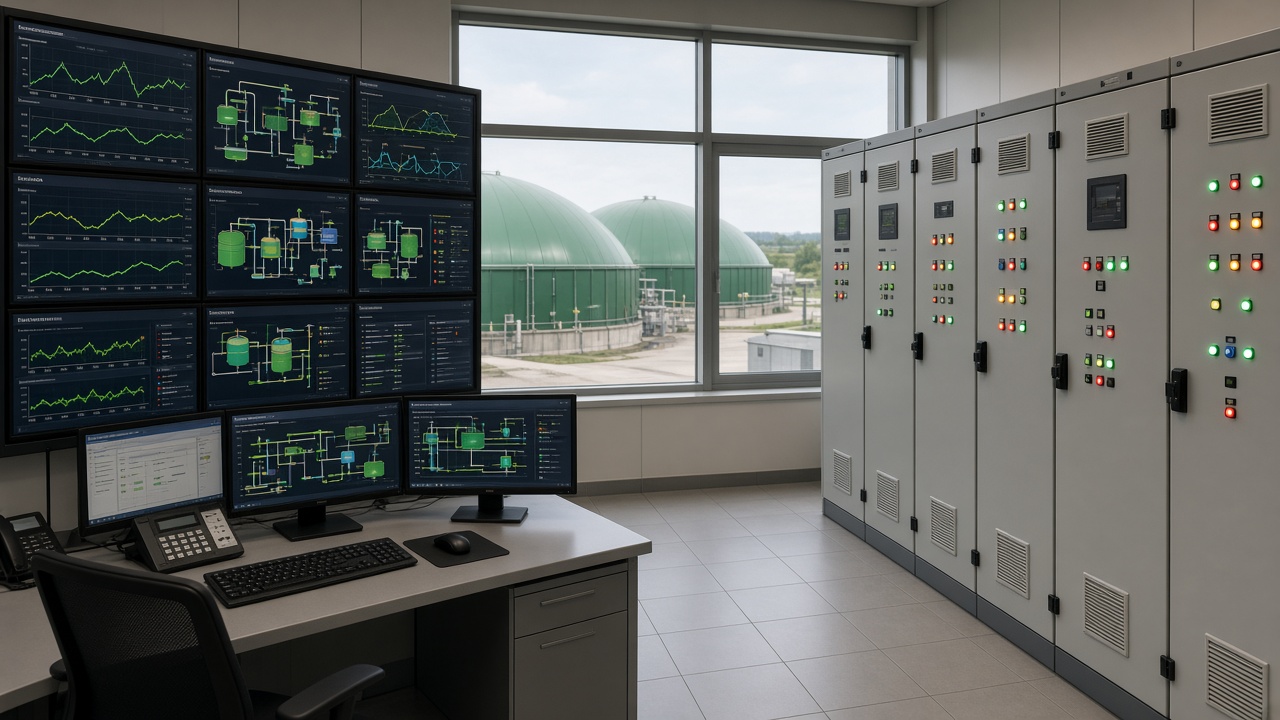
Automation is how the plant is seen and how it is stopped. Instruments measure the process. A programmable logic controller runs the sequences and the trips. SCADA is the screen the operator watches: the present value, the alarm, and the trend of the last hours. Without that chain a digester, a scrubber, or a boiler is a set of tanks that nobody can run to a limit.
The instruments follow the process, not a generic list. On a digester they are level, temperature, pressure, and gas flow, and the composition of the biogas: methane, carbon dioxide, hydrogen sulfide, and oxygen. Oxygen in a fuel-gas line is a trip. It is not a trend to look at after the shift. On a biological scrubber they are the liquid flow, the condition of that liquid, and the hydrogen sulfide leaving the column. On a steam boiler they are drum level, steam pressure, and the flame. On hydrogen compression and container storage they are suction and discharge pressure, temperature, and a gas detector in the container bay. A laboratory sample still matters. Chemical oxygen demand and a gas analysis confirm what the instrument has been saying. The instrument is what the plant acts on between samples.
The controller holds the sequences and the interlocks. A feed pump starts only when the receiving tank has room. A compressor starts only when suction pressure, cooling, and the downstream path are inside the limits written for it. A high digester pressure, a low boiler drum, or oxygen in the biogas opens the flare or shuts the fuel path, and does not wait for someone to notice a screen. Those actions are written as a cause-and-effect list before any code is written, so the code can be tested against a document.
SCADA is that same list, drawn so a shift can use it. Each measurement has a range, a unit, and an alarm that means a specific thing. A value that is not stored is useless the week the biology drifts, so the historian is part of the system. The same screens can be viewed away from the site. That view does not replace the person on shift.
The controller is not the protection on the high-voltage network. Those relays clear a fault on their own. The automation sees breaker status and uses it in a process interlock. It does not grade the site protection, and it does not dispatch the solar array and battery. It needs to know whether that supply is there, because a compressor or a boiler feed pump that starts into a dead board is not a successful sequence.
The size follows the plant. A pilot skid may be one cabinet and a local panel. A site with digestion, upgrading, a boiler, and a substation is several controllers, one in each process area, reporting to one SCADA. Each area still has to trip on its own if the network between the cabinets fails. Design, installation, and commissioning of this system are a service.